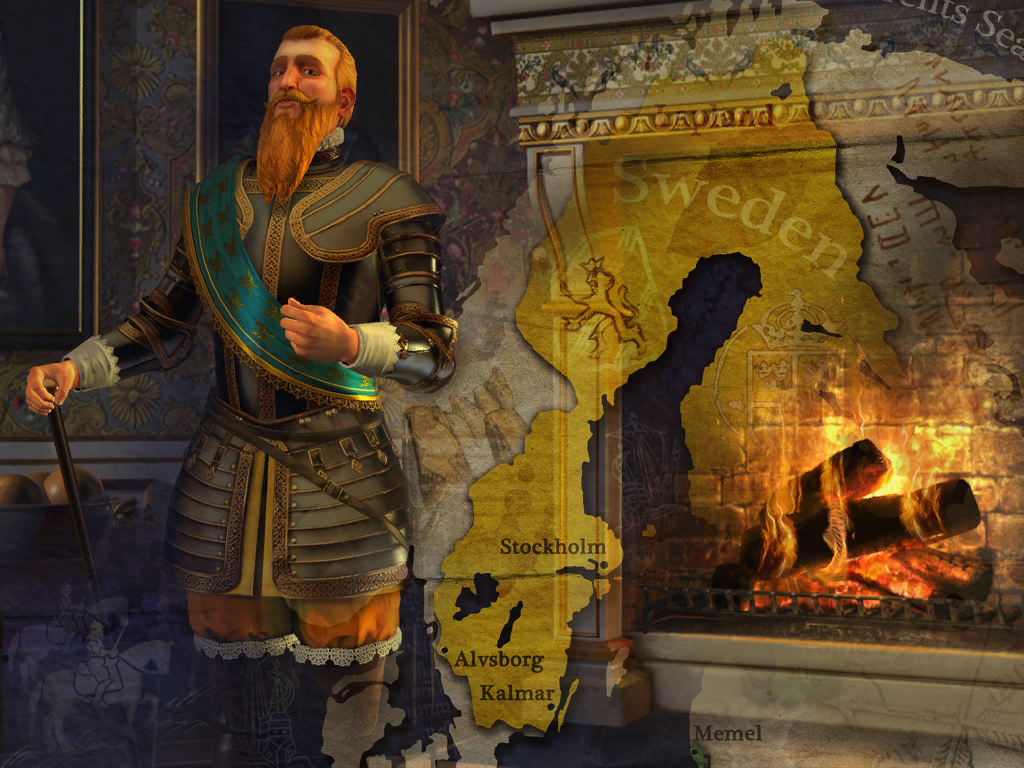
Looking at the dates of the screenshots, I played the first attempt with Sweden in the Into the Renaissance scenario back in 2018. I will write a follow up post on all (major) unsuccessful attempts with Sweden, but here it is: The ultimate Sweden Deity guide for Into the Renaissance! (Also: There will be a guide for Sweden beyond Victory, since between turn 200 and 318 I conquered the entire map.)
End of the Viking Age
First as usual, here’s a historical overview of Sweden at the time! Around 1095 AD, Sweden was transitioning out of the Viking Age into the High Middle Ages. The decline of traditional pagan customs and the consolidation of Christian missionary efforts led to the gradual unification of the Goths and Swedes under a centralized monarchical system. The end of maritime raiding shifted society away from seasonal plunder and toward settled agrarian feudalism, European diplomatic networks, and trade partnerships within the Baltic region. Early Swedish kings worked to establish institutional control, legal codes, and ecclesiastical structures, laying the groundwork for a recognized medieval state integrated into the broader realm of European Christendom.
The Kalmar Union
The middle of this era was defined by internal conflicts, territorial expansion into Finland, and eventual regional integration. In 1397, Sweden, Denmark, and Norway formed the Kalmar Union under a single monarch to counter the commercial dominance of the Hanseatic League. While intended to unite Scandinavia, the union was marked by persistent friction between the Swedish nobility and centralizing Danish monarchs. Tensions culminated in the early 16th century with the Stockholm Bloodbath of 1520, where Danish King Christian II executed dozens of Swedish nobles and leaders. This brutality ignited a national uprising led by Gustav Vasa, who drove out Danish forces, dissolved the Kalmar Union, and was elected King of Sweden in 1523. (That backfired, eh?)
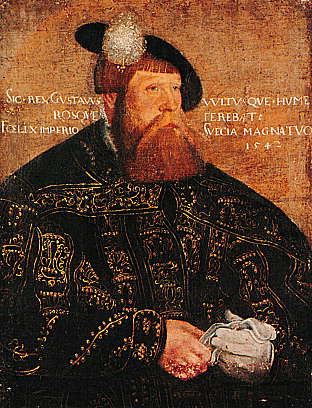

Hmm… Look at these two. Besides the Danish having been painted by famous German painter Lucas Cranach and therefore being high definition, they look like brothers, eh? Anyways…
Early Swedish Empire
Under Gustav I (Vasa) and his successors, Sweden underwent dramatic institutional transformation during the 16th century. King Gustav established the Vasa dynasty, introduced a hereditary monarchy, and spearheaded the Swedish Reformation by adopting Lutheranism (which in this scenario would be a huge boost!), which allowed the Crown to expropriate monastic wealth to rebuild the state treasury and army. By 1595 AD—marked by the conclusion of the Russo-Swedish War (oh hell what a Civ5-war it will be) and the Treaty of Teusina—Sweden had secured vital territorial holdings in Estonia and along the Gulf of Finland. The country transformed from a fractured regional realm into a centralized, military-focused nation-state, fully poised to rise as a dominant European Great Power in the 17th century!
1. Introduction & Scenario Setup
Sweden’s Unique Traits:
- Utilizing the scenario-specific Viking Fury ability (embarked units gain +1 Movement and expend only 1 movement point landing from sea to land, while melee units pay no movement cost to pillage) we will wreak havoc amongst European and the Middle East. Embark units (also trebuchets and cannons) to next turn disembark, march into enemy territory, setup and fire! Amazing! It’s also incredibly useful for quick settling of the Baltics since your settlers will need any advantage they can get to beat the Dutch (to the best spots).
- Sweden’s Unique Unit, the Hakkapeliitta is a perfect match for Swedens UA!
- The Stave Church has no maintenance cost and takes half the time to produce as the Temple, which it replaces.
2. The Expansion Phase: The 11-City Empire (Turns 1–80)
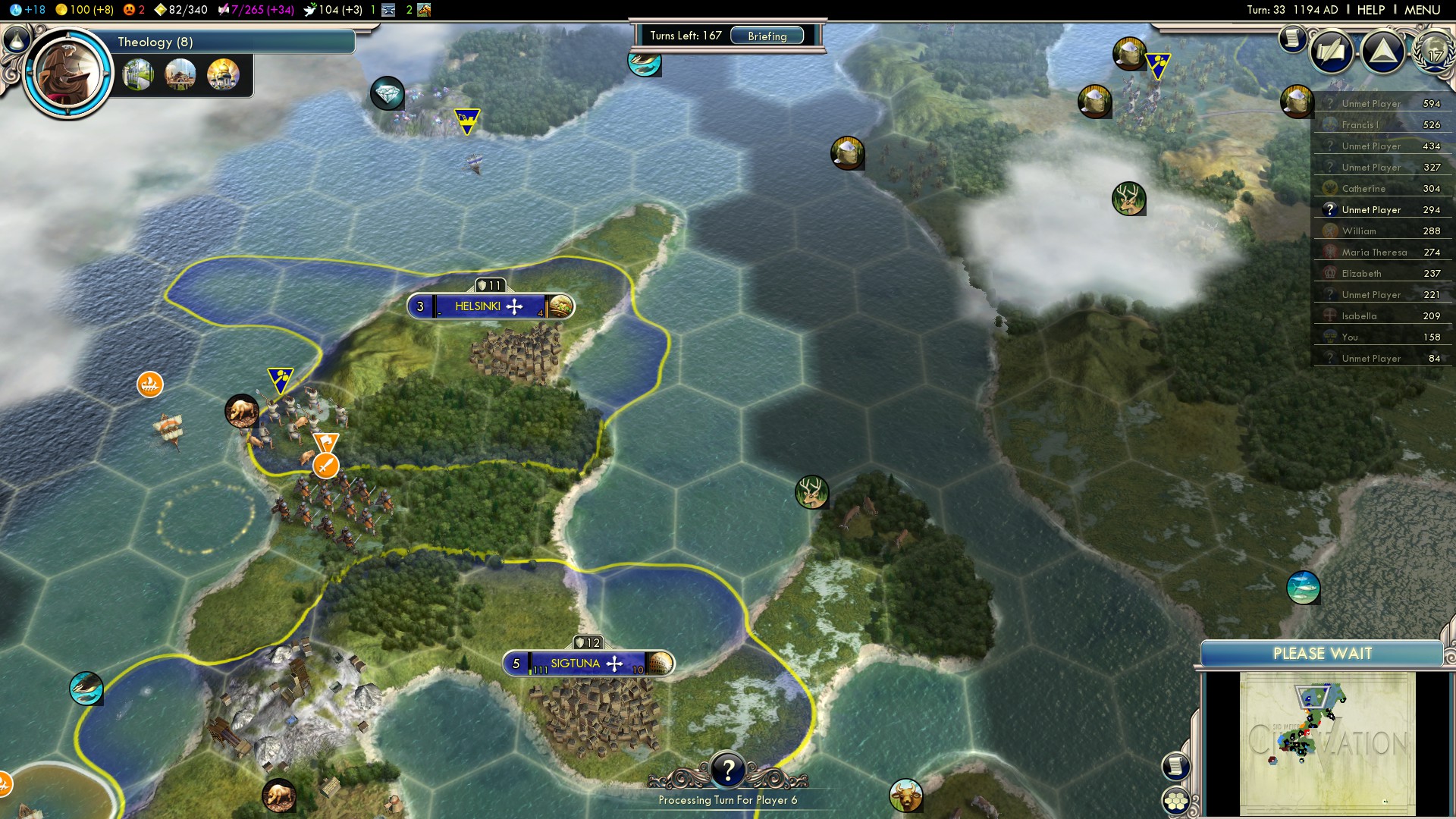
Rapidly expanding into an extensive 11-city network during the earliest turns forms the backbone of Sweden’s victory strategy on Deity. Securing early control over key Scandinavian and Baltic territory is required to effectively contain mainly the Netherlands before their military and economic engines is on full steam (haha!). By aggressively pushing city foundations outward, you’ll box the Dutch in, choking off their potential land expansion.
Concurrently, establishing early coastal strongholds (or is it weakholds, if you’re still weak?) in max. city range, you’ll effectively seal off crucial spots across the Baltic Sea. This prevents both Austria and Russia from securing ports and pestering the Baltic Sea (“Mare Nostrum”) with their super early Privateers and Frigates.
Establishing this defensive wall early guarantees that you, Sweden, retain absolute naval dominance across Northern Europe while building the vast production base required for the global campaign.
Strategic City Foundations
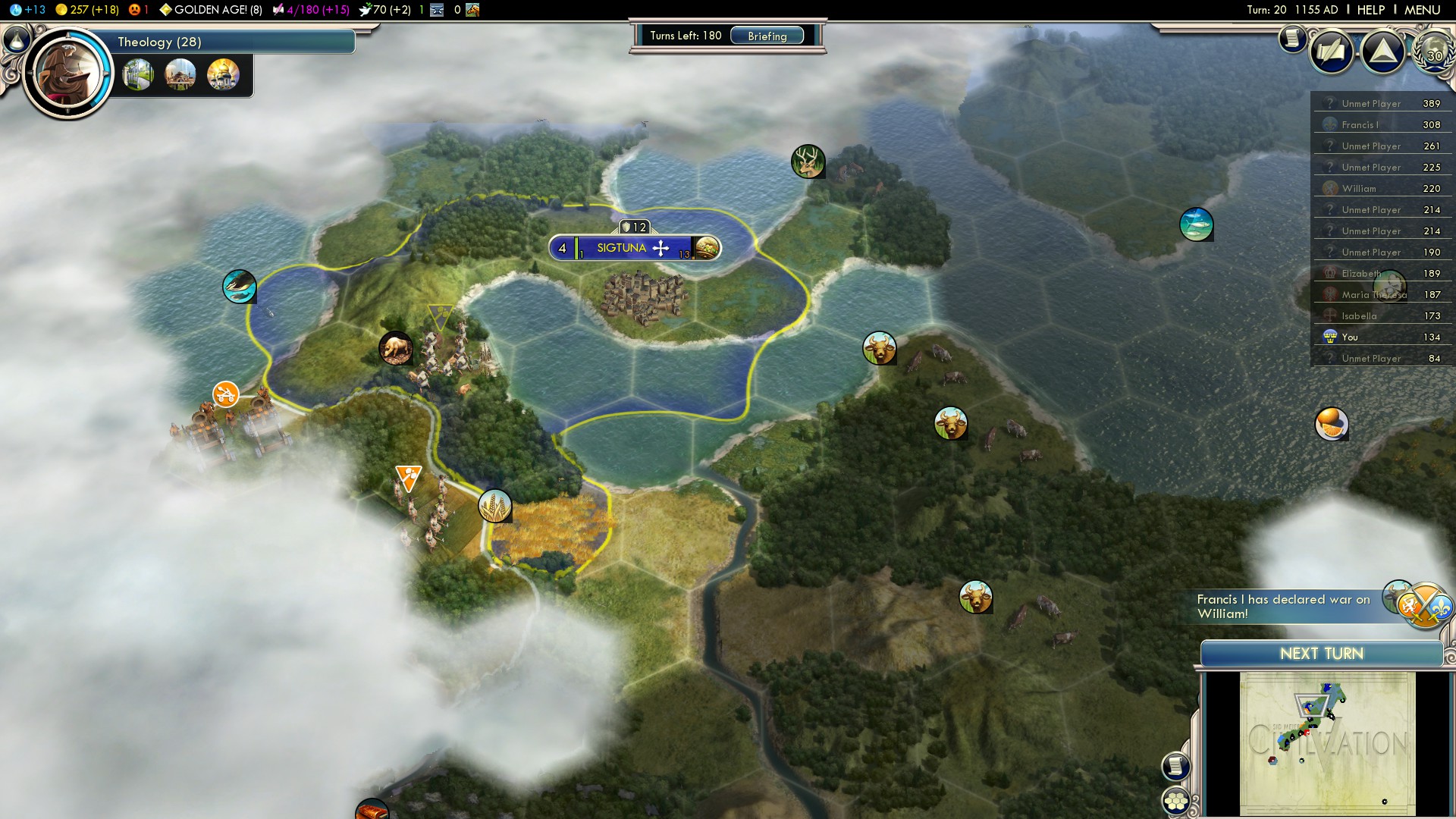
- Stockholm (Capital)
- Sigtuna (South Denmark / Jutland Chokepoint) — so Netherlands can’t found Hamburg or elsewhere in Northern Germany
- Helsinki (Turn 25 – North Denmark) — so Netherlands can’t sail north to Norway
- Birka (Turn 35 – South Sweden) — so Netherlands can’t settle the Polish coast
- Uppsala (Turn 42 – Norway) — because soon the others will have Compass and can sail the ocean
- Turku (Turn 46 – Estonia) — hurry before the Russians arrive
- Linköping (Turn 51 – Estonia) — see above
- Lund (Turn 60 – Central Sweden)
- Espoo (Turn 66 – Oslo Region)
- Malmö
- Västerås
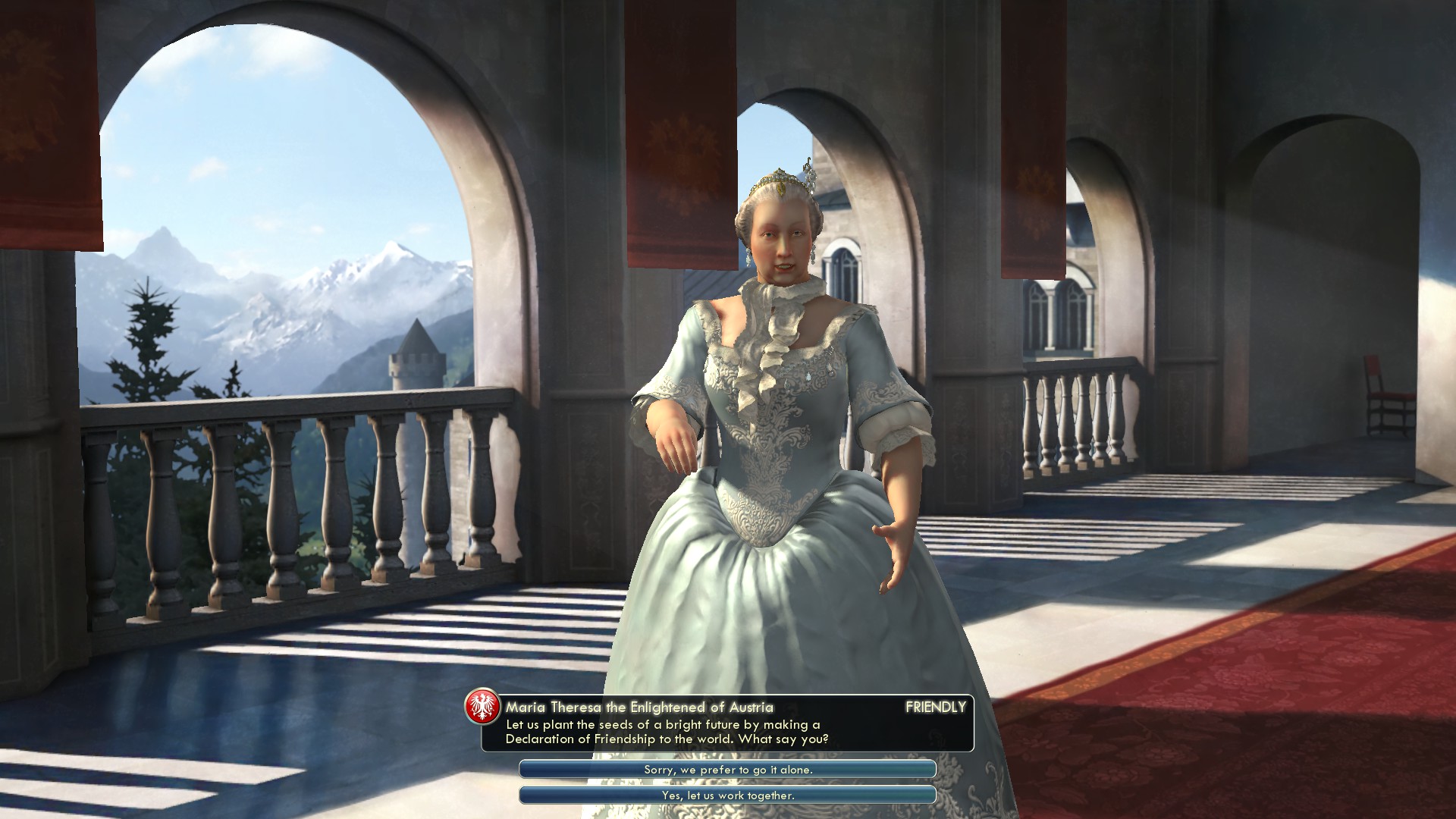
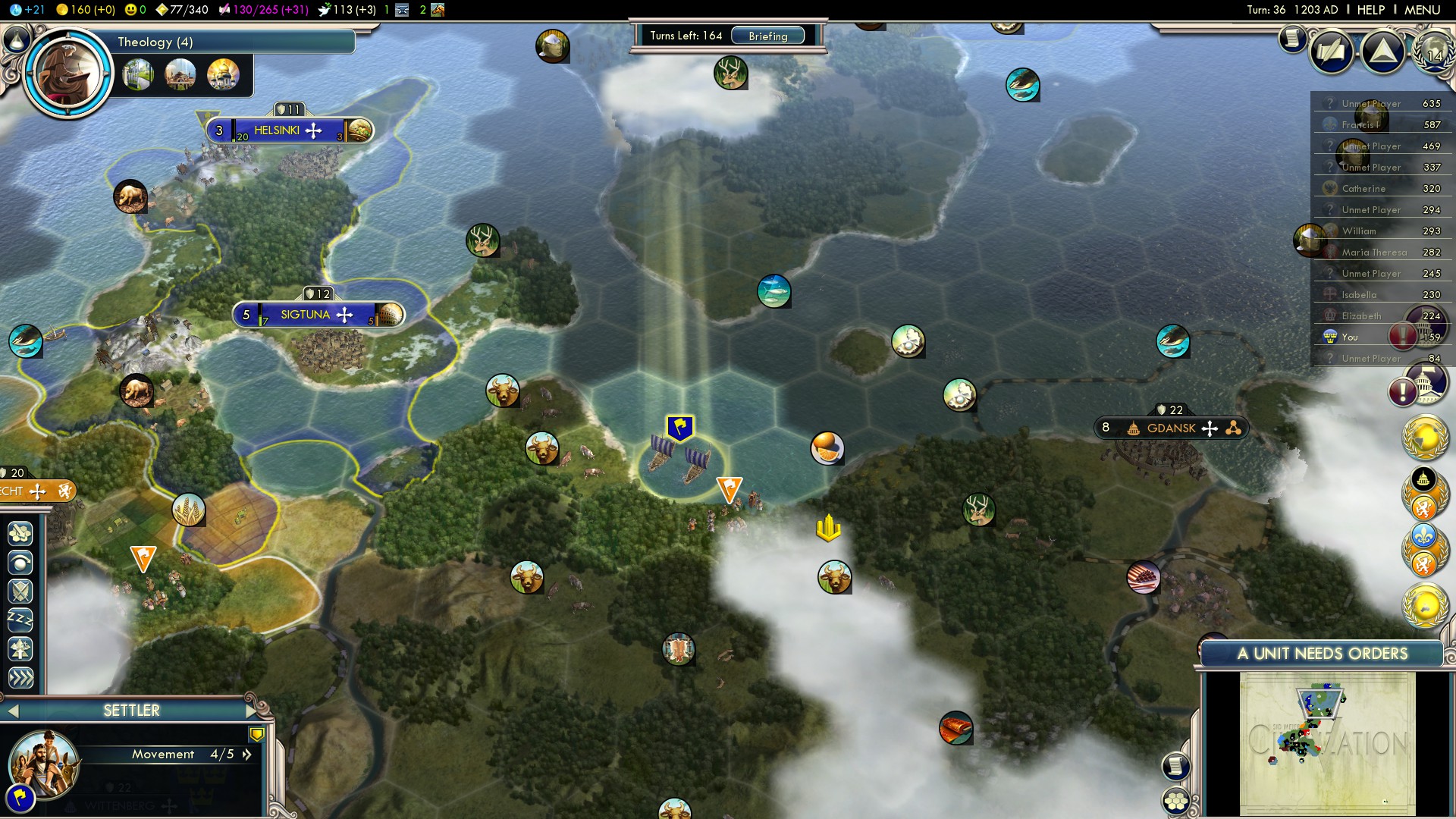
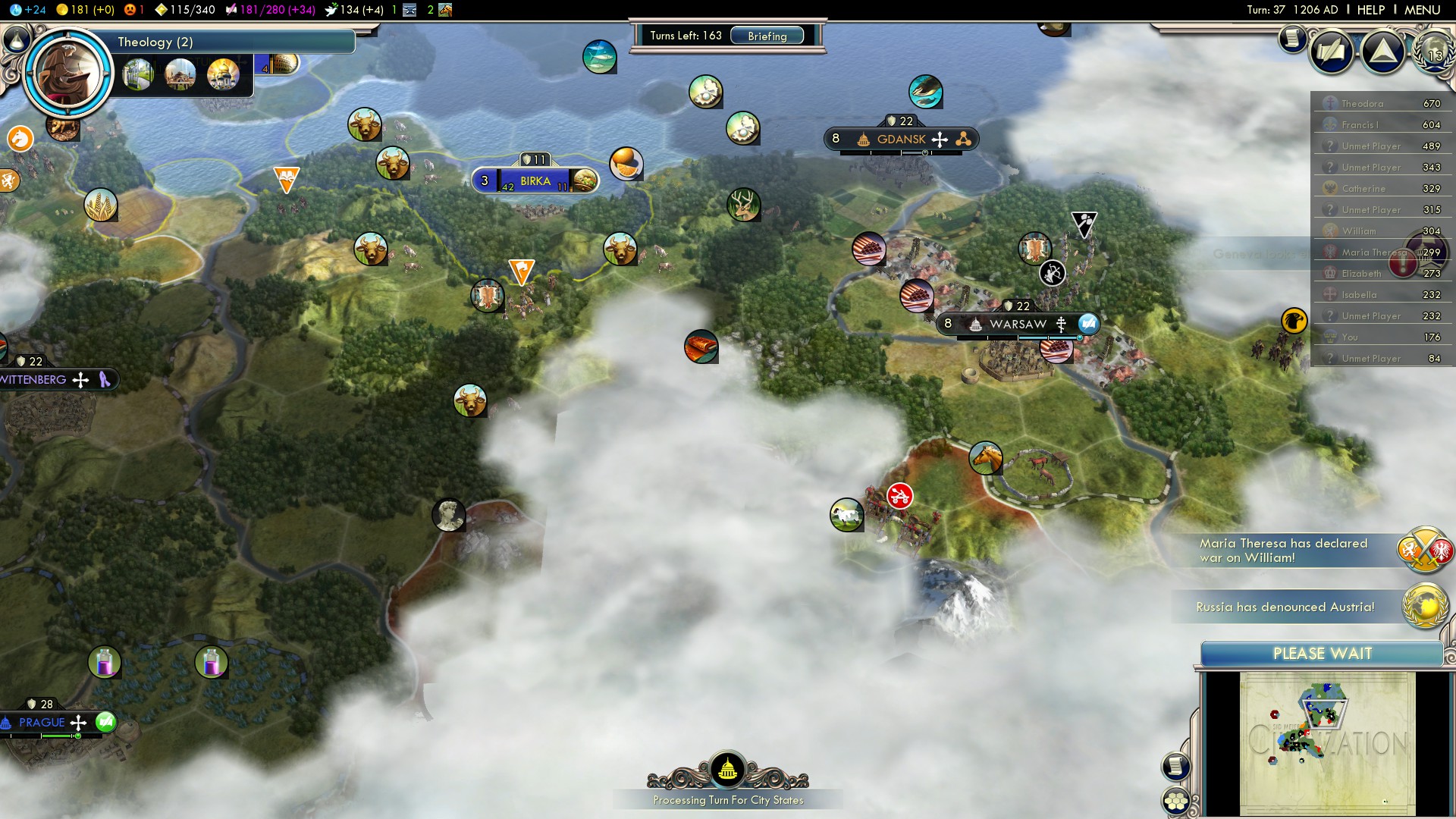
Especially in the early phase, diplomacy is just as crucial as city placement. You don’t have an army and you can’t afford one either. So: Bribe Europeans against each other. Never befriend any, because for each friend you’ll get two enemies. If the Netherlands beat you to a strategic city location, reload and be faster next time.
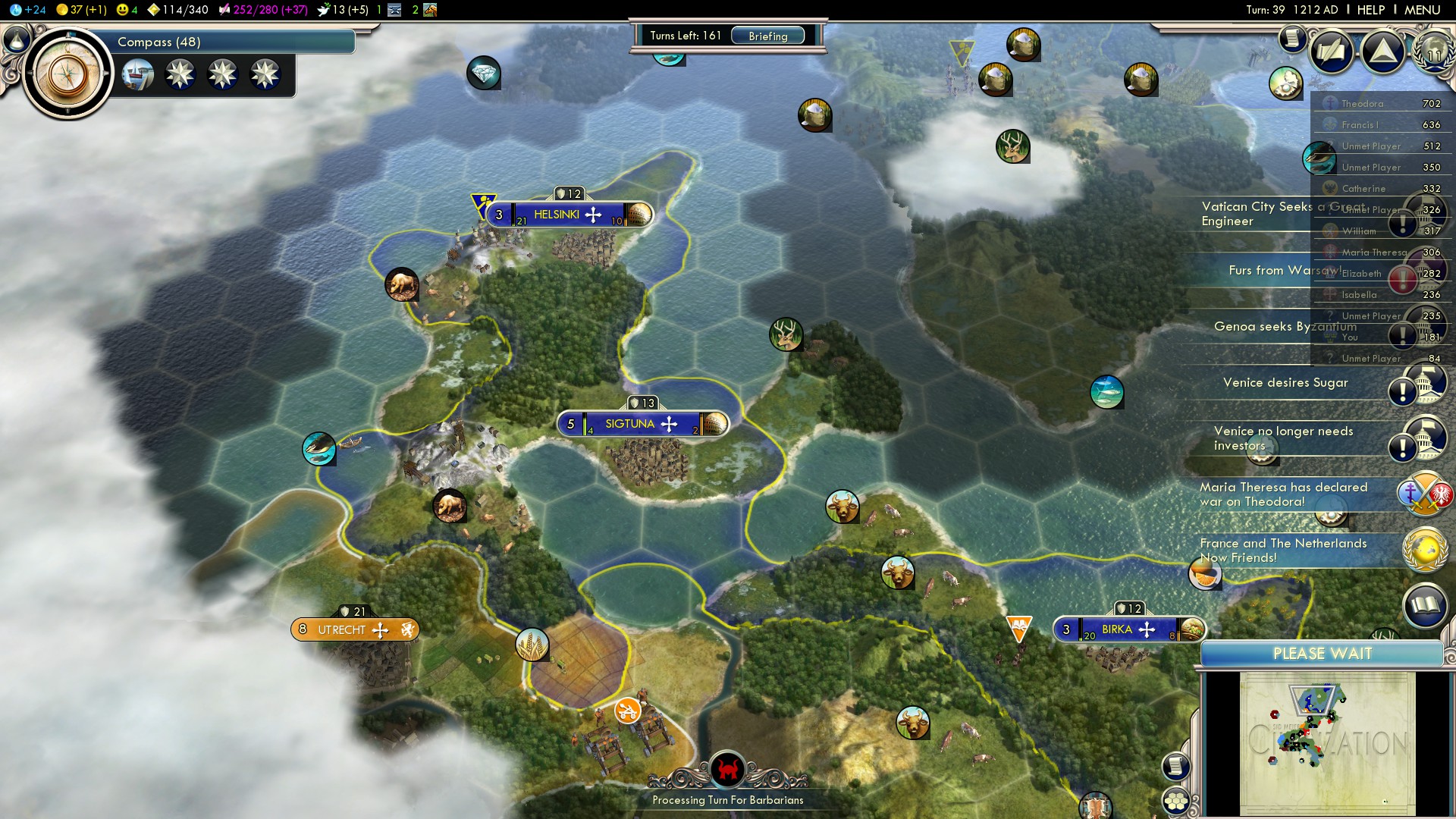
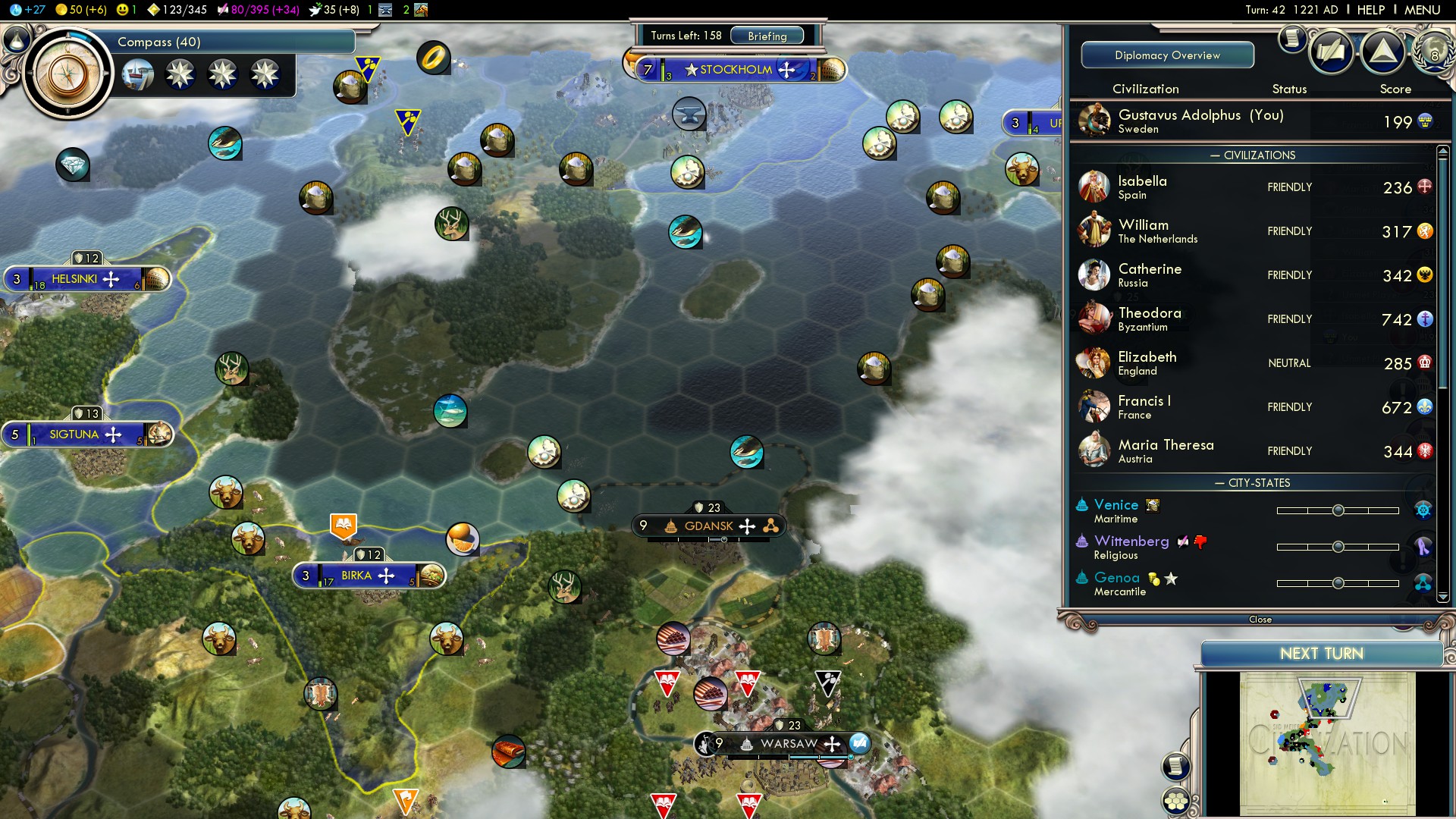
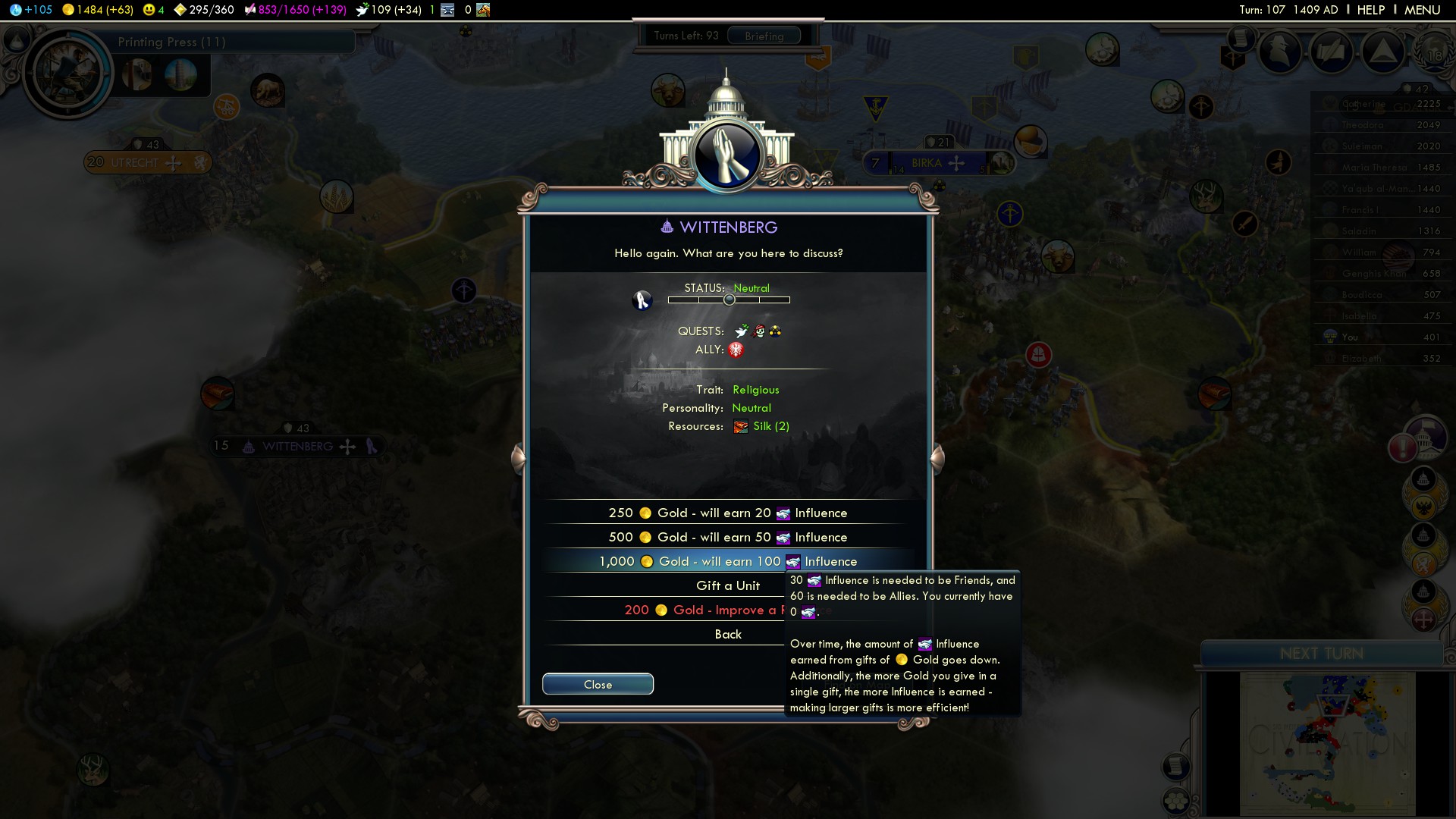
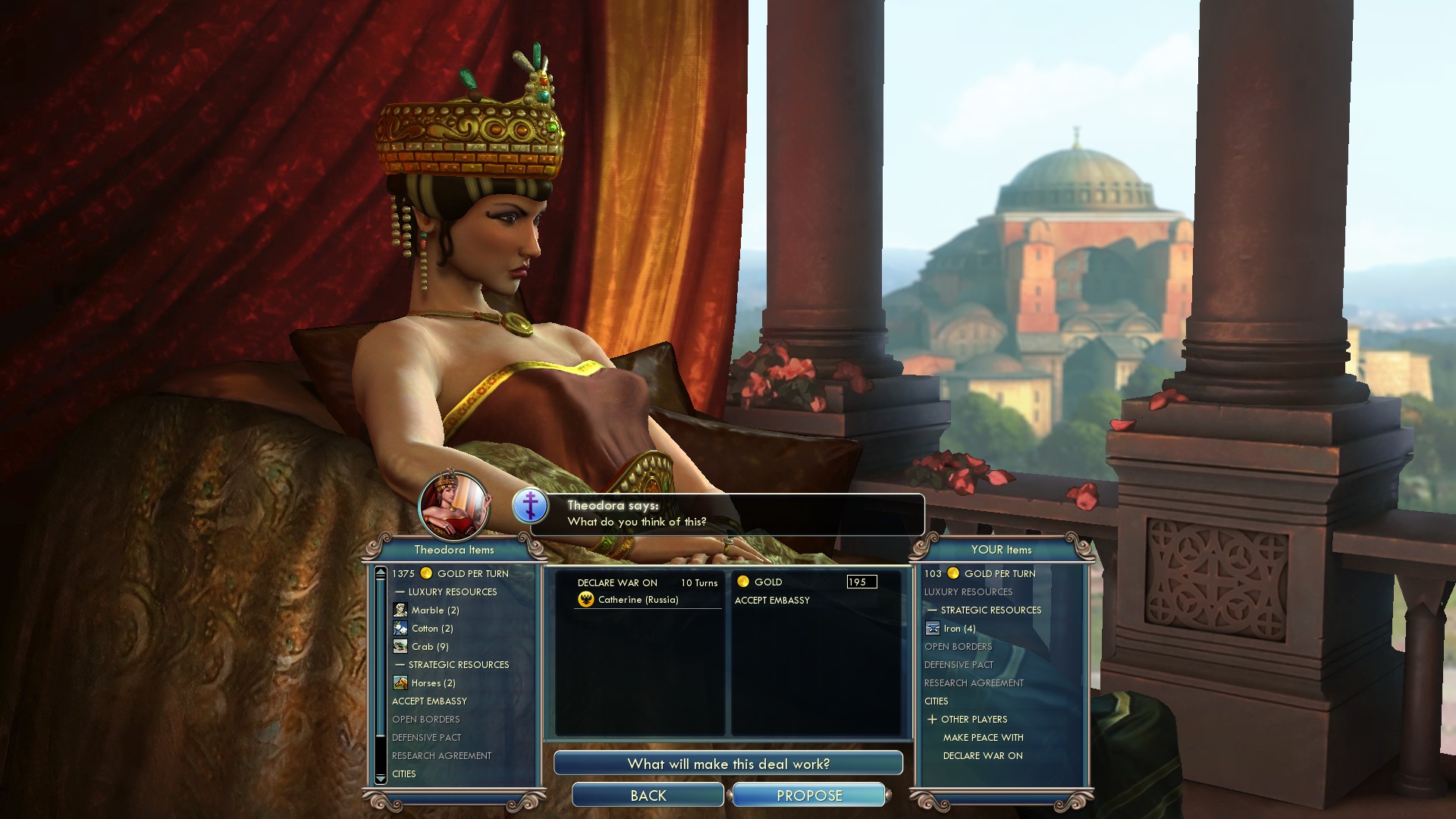
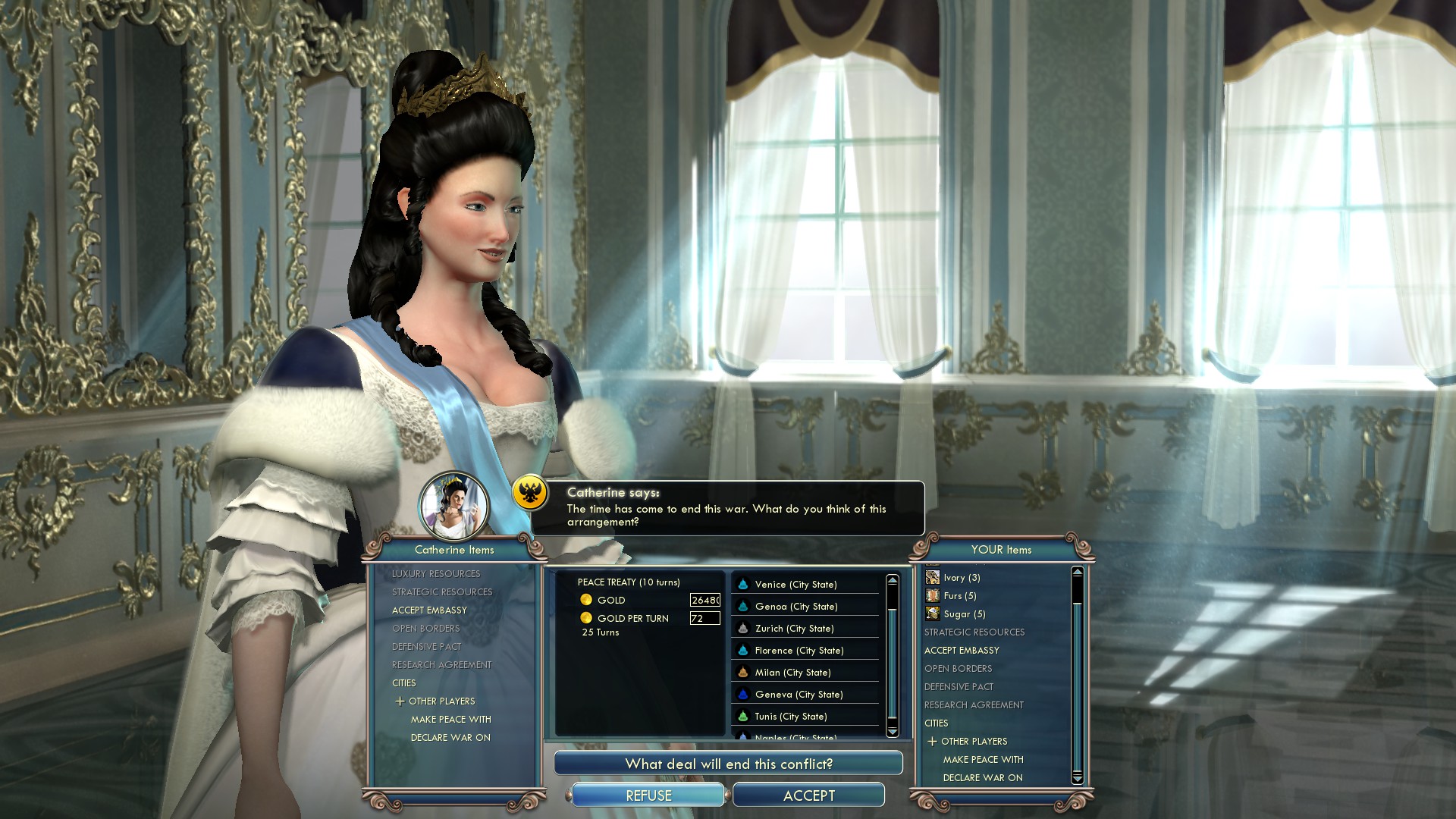
If Civs next to you ask you whether you shall wage war against African civs — say yes! They will never reach you and it’ll improve your standing with your neighbors. Also: When making peace a couple of dozen turns later, you’ll get Gold and GPT:
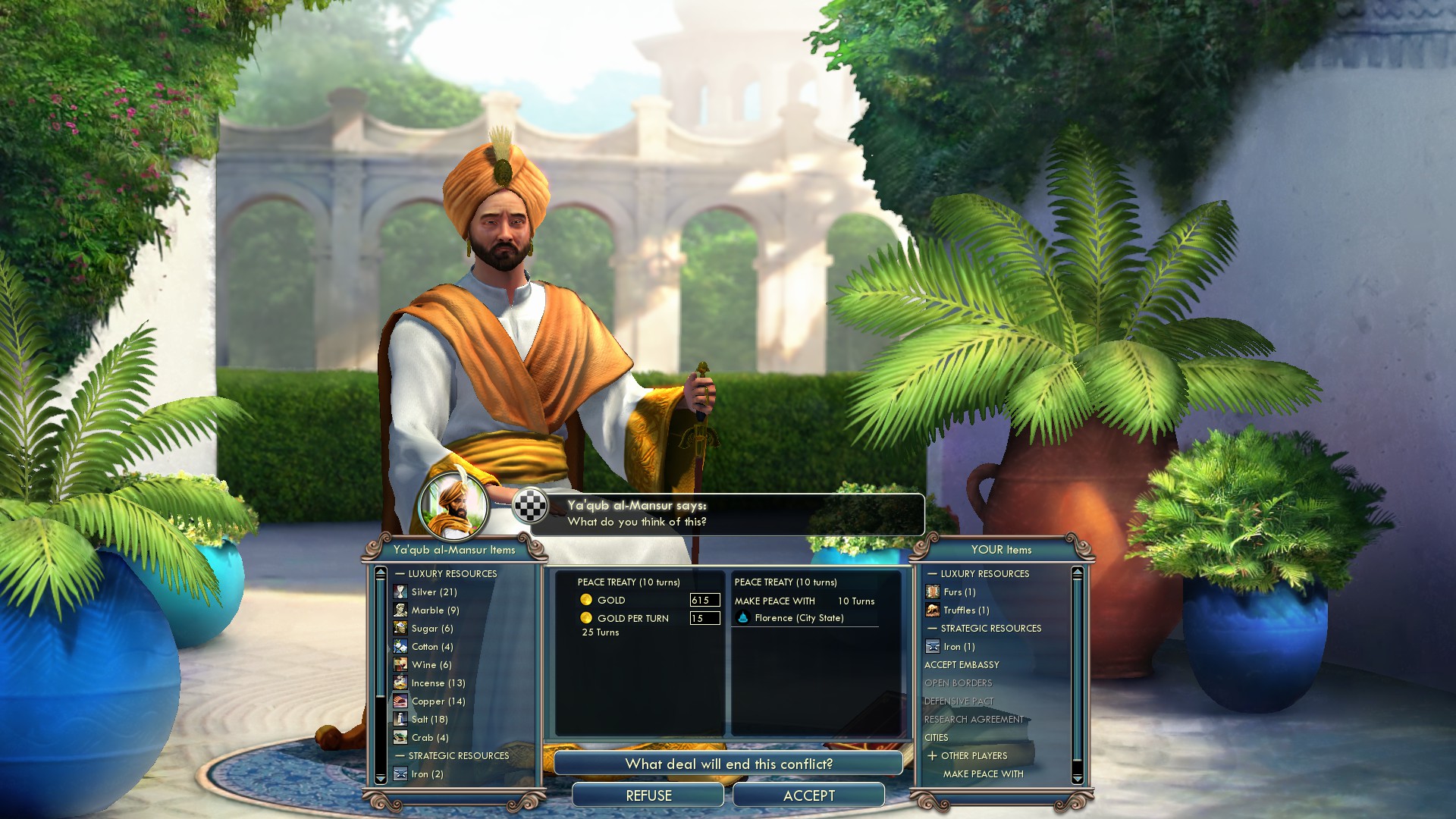
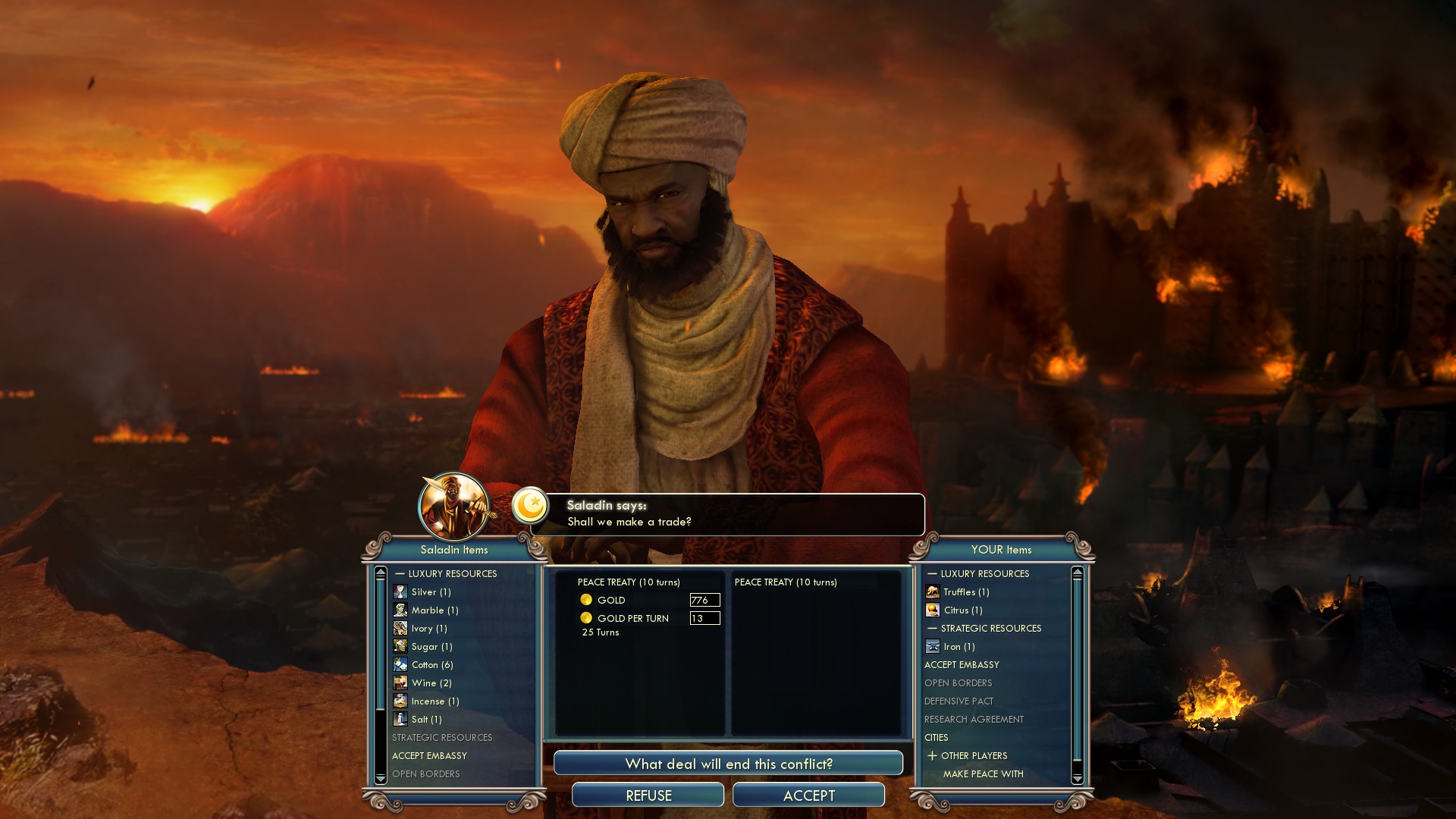
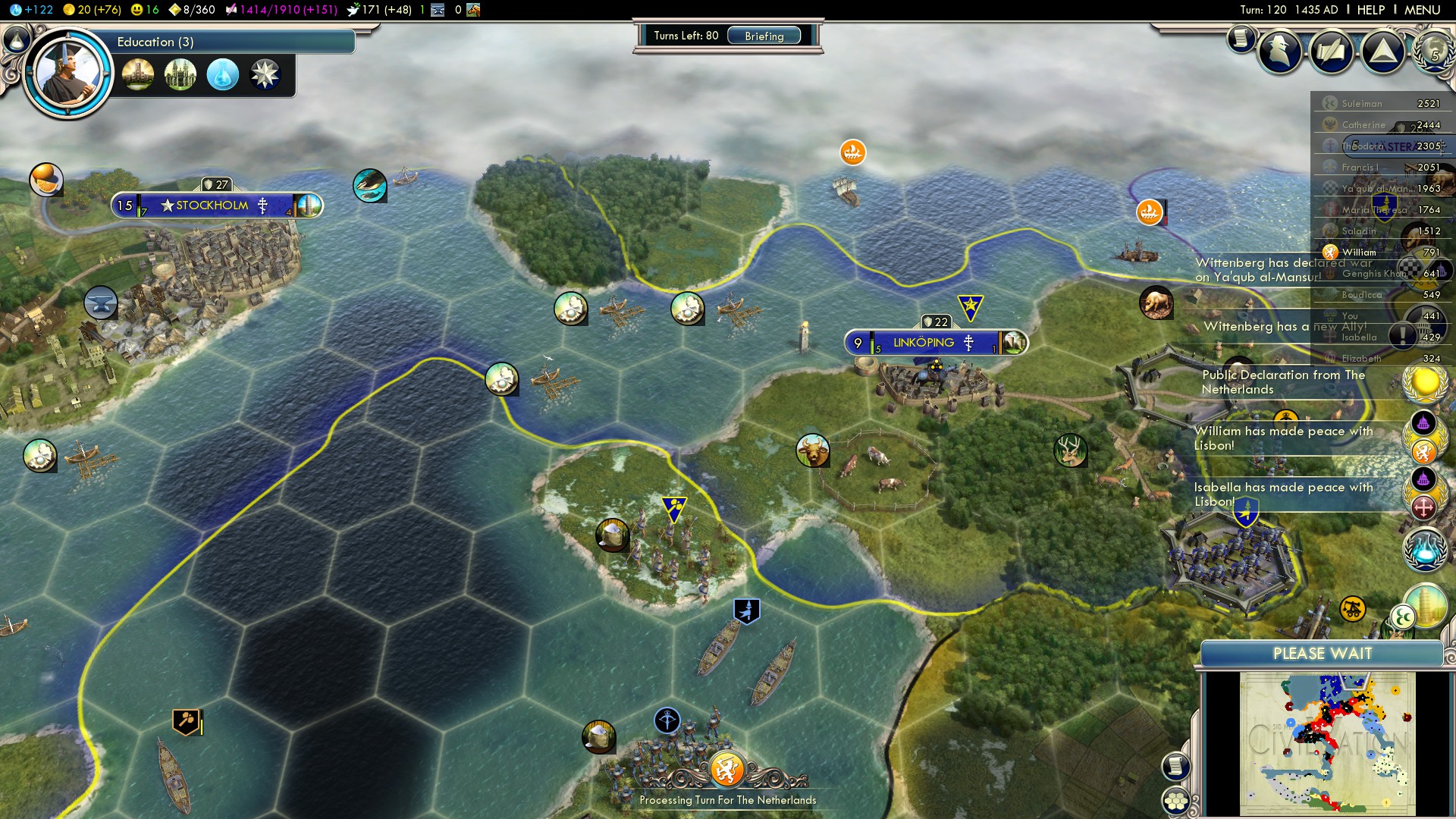
Don’t know what happened with Västerås. I think it annoyed the Russians, so I sold it to Byzantium for lots of GPT. Remember the main goal is to prevent Russian ports in the Baltics. You’ll get that city back either way.
City builds & chronology
Here’s the build order to get your economy started, keep the empire happy and expansion going:
| Turn | 1. Stockholm | 2. Sigtuna (south DK) | 3. Helsinki (north DK) | 4. Birka (south SWE) | 5. Uppsala (Norway) | 6. Turku (Estonia) |
| 1–20 | Lighthouse ? WB ? WB | |||||
| 21–24 | Settler #1 (21) | Worker | ||||
| 25–27 | Founded (25) | |||||
| 28 | Watermill | Market | ||||
| 29–34 | Settler #2 | |||||
| 35 | Settler #3 | Colosseum | Market | Founded (35) | ||
| 36–41 | Settler #4 | WB ? Worker | Colosseum | Market | ||
| 42–45 | Settler #5 | Amphitheater | WB | Founded (42) | ||
| 46–50 | Colosseum | Stave Church | Amphitheater | Colosseum | Founded (46) | |
| 51–61 | Stave Church | Library | Amphitheater | Market | ||
| 62 | WB | Stable | Market | |||
| 63–65 | Settler #6 | Harbour | Colosseum | |||
| 66–76 | Settler #7 | Walls | Colosseum | |||
| 77+ | (Cbow / troops) | Stave Church |
3. Research & Social Policies
Here’s my research path in this Sweden Deity game and some explanations why one tech or the other was more beneficial at the time. The gist is: Since you’re spreading out quite quickly (for Deity standards!) you need to both keep your empire happy (thus happiness buildings and policies) and the economy running in order to not fall further behind.
The tech path reflects this at every turn. The huge military buildup, compared to other scenario guides for Into the Renaissance, comes relatively late. To balance that out you get a pretty damn big empire to begin with!
- Theology (39), the basis for both Compass and Education
- Compass (68), so you can finally connect your cities across the Baltics and fix the economy
- Civil Service (76) for more growth from farms
- Metal Casting (84) for workshops
- Guilds (90) heading for
- Machinery (101) for finally building xbows ? Chivalry stolen
- Printing Press (116) for more happiness if needed
- Education (122) for universities and (eventually) Oxford
- Humanism (132) for even more culture and employing more Artists (you don’t want to grow cities beyond 10 pop anyways ? Economics stolen (134)
- Astronomy (142) ? Physics stolen (143)
- Navigation (144, Oxford)
- Steel (147)
- Gunpowder (153)
- Metallurgy (158)
- Chemistry (164) for finally upgrading to Cannons
- Banking (170)
- Exploration (176)
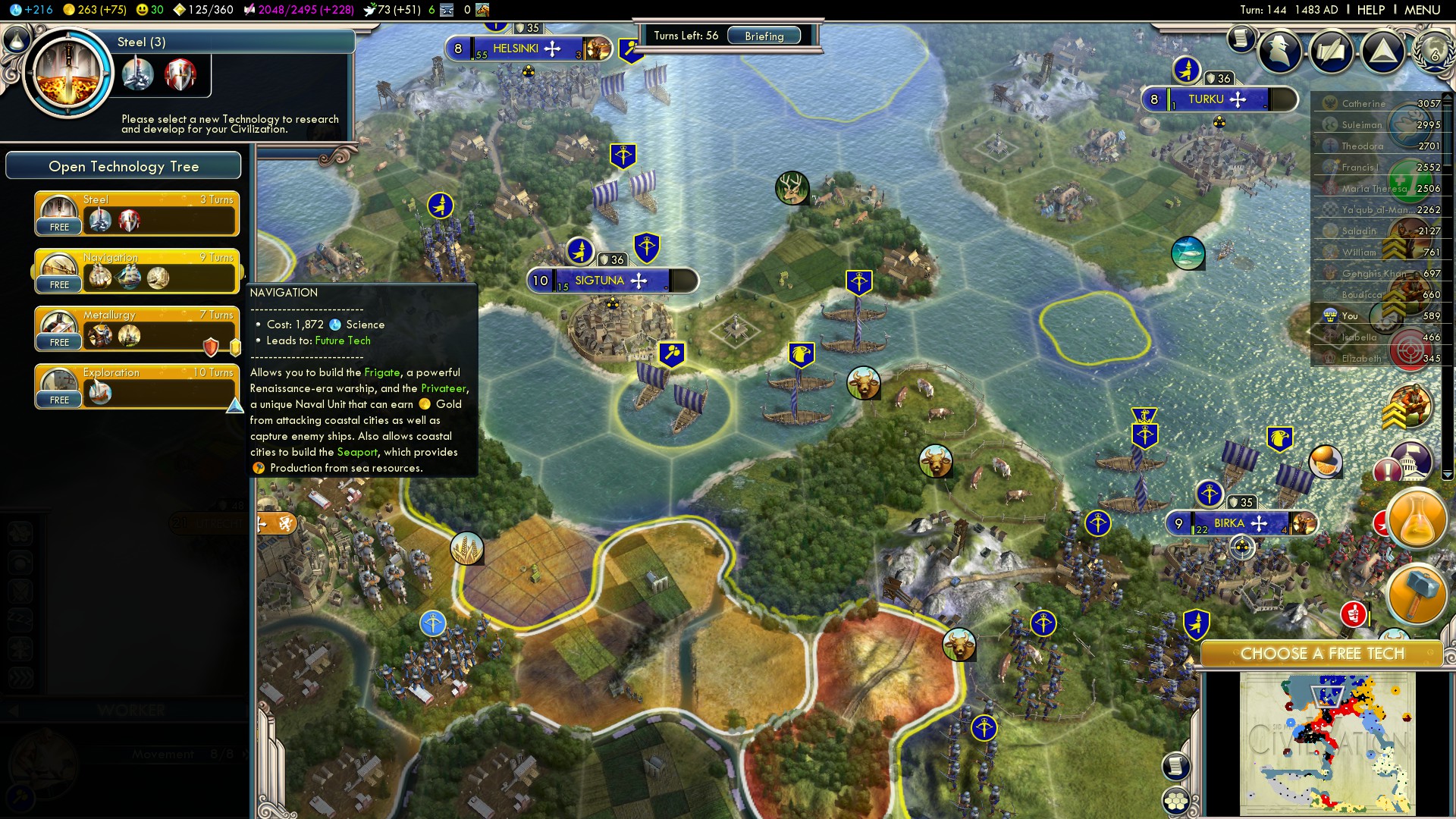
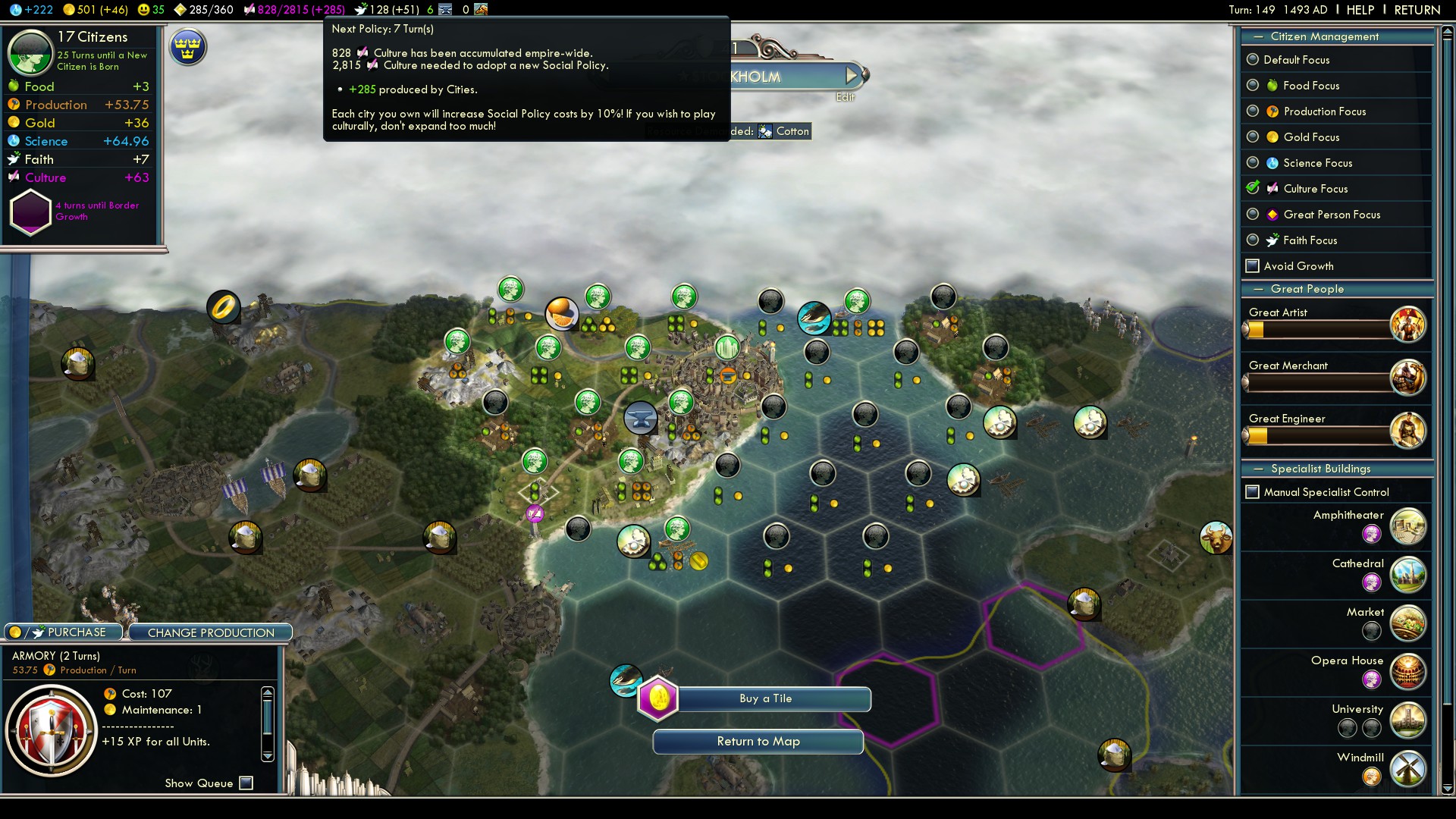
Culture & Social Policies:
First on Social policies in general: The only way to get many policies and keep your ever expanding empire happy and your ever growing army powerful is to staff ALL culture buildings. Every Amphitheater built will be worked. Every Cathedral (from your Catholic cities) will be worked. And as soon as you get there every Opera House will be worked as well.
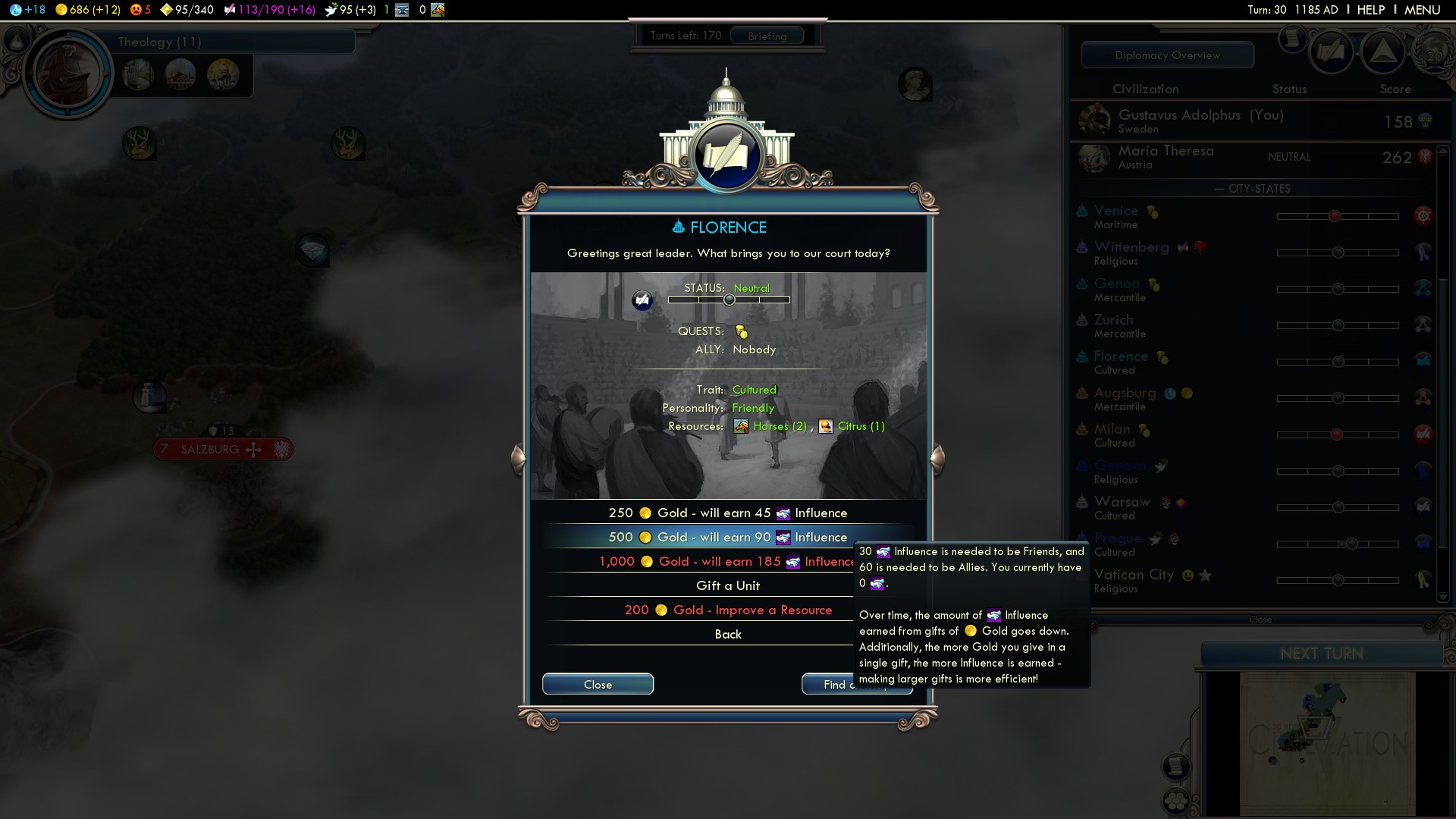
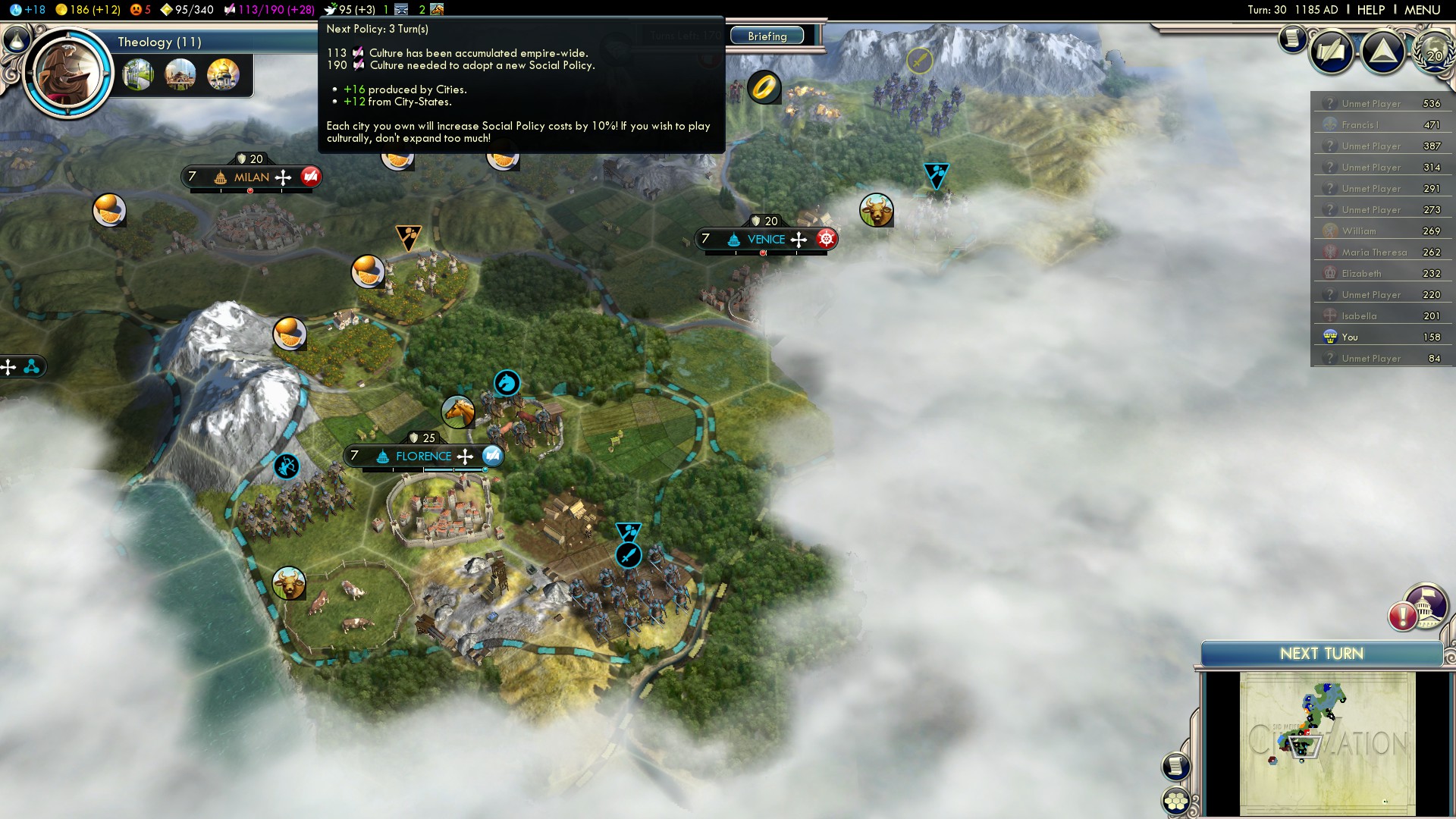
A welcome early boost is allying Florence or any other Cultural City State to the South. Later it won’t matter much, but early on (see picture from turn 30) it boosted my Culture output from 16 to 28, which is +75%!
Order of policies adopted:
- Liberty! Liberty, Liberty, Liberty!
- Obviously free Settler first
- Then rush for +happiness from connected cities
- Finish Liberty by turn 32
- Turn 40: Commerce
- Since all your cities are coastal, first go for Merchant Navy before finishing the right Commerce-tree.
- Turn 113: Warrior Code (Honor 1)
- Get to double XP before finishing the right Honor-tree.
- Turn 146: Military Caste
- Turn 156: Professional Army
- (Wildcard: I took Piety, but it’s kind of wasted… but I only got to the Industrial age later.)
- Turn 179: In time for the late game conquest – Autocracy! 10 culture as plunder for each point of culture produced in a captured city. What a great boost.
4. The Russo-Swedish War & Deity Victory
Starter: Swedish-Austrian War of the Baltics
The main reason why it’s so important to deny the Netherlands access to Denmark and Norway is that with many coastal cities they’ll do more research, reach Navigation super early and will overwhelm you with Privateers and Frigates!
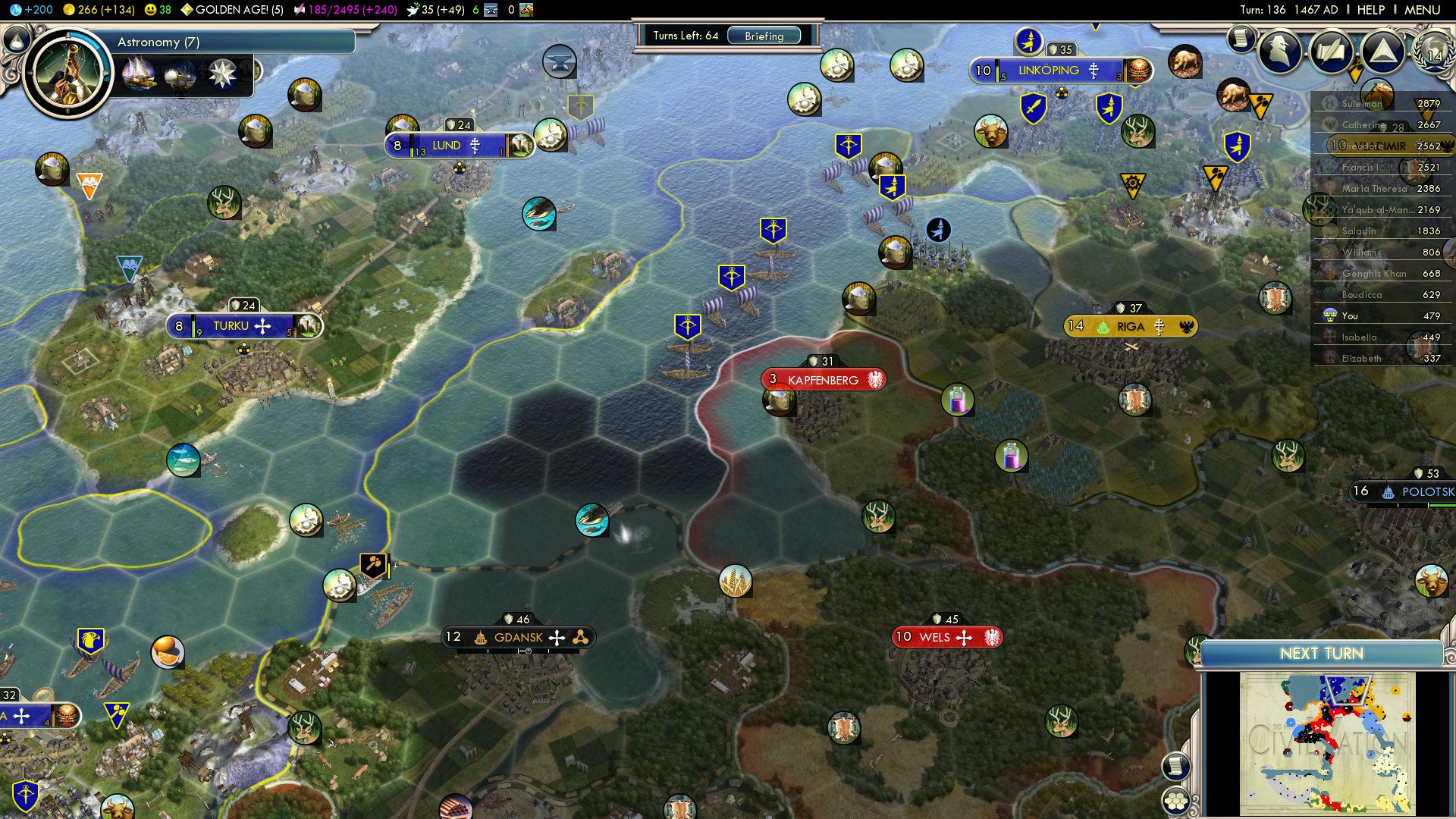
While with above settling-plan and build strategy that goal can be achieved, in my game the Austrians snuck 1 tiny city to the coast of the Baltic Sea. And that’s where the war started. Of course don’t go in solo, otherwise you’ll bear the might of the entire AIs military and productive capacity. In my game I bribed Byzantium to go to war with me, taking the edge off the Austrian land power.
| Turn | City (Population) | Yield | VP | Total VP |
|---|---|---|---|---|
| 140 | Kapfenberg (3) | — | 75 | 75 |
| 151 | Wels (9) | — | 225 | 300 |
| 162 | Warsaw (13) | — | 325 | 625 |
| 165 | Warsaw (6) | — | 150 | 775 |
With a small army it was possible to Capture Kapfenberg and Wels and liberate Warsaw within almost 30 turns. It was the fastest I could do it. The war ended after 33 turns in 173 with a comfortable Gold and GPT peace treaty.
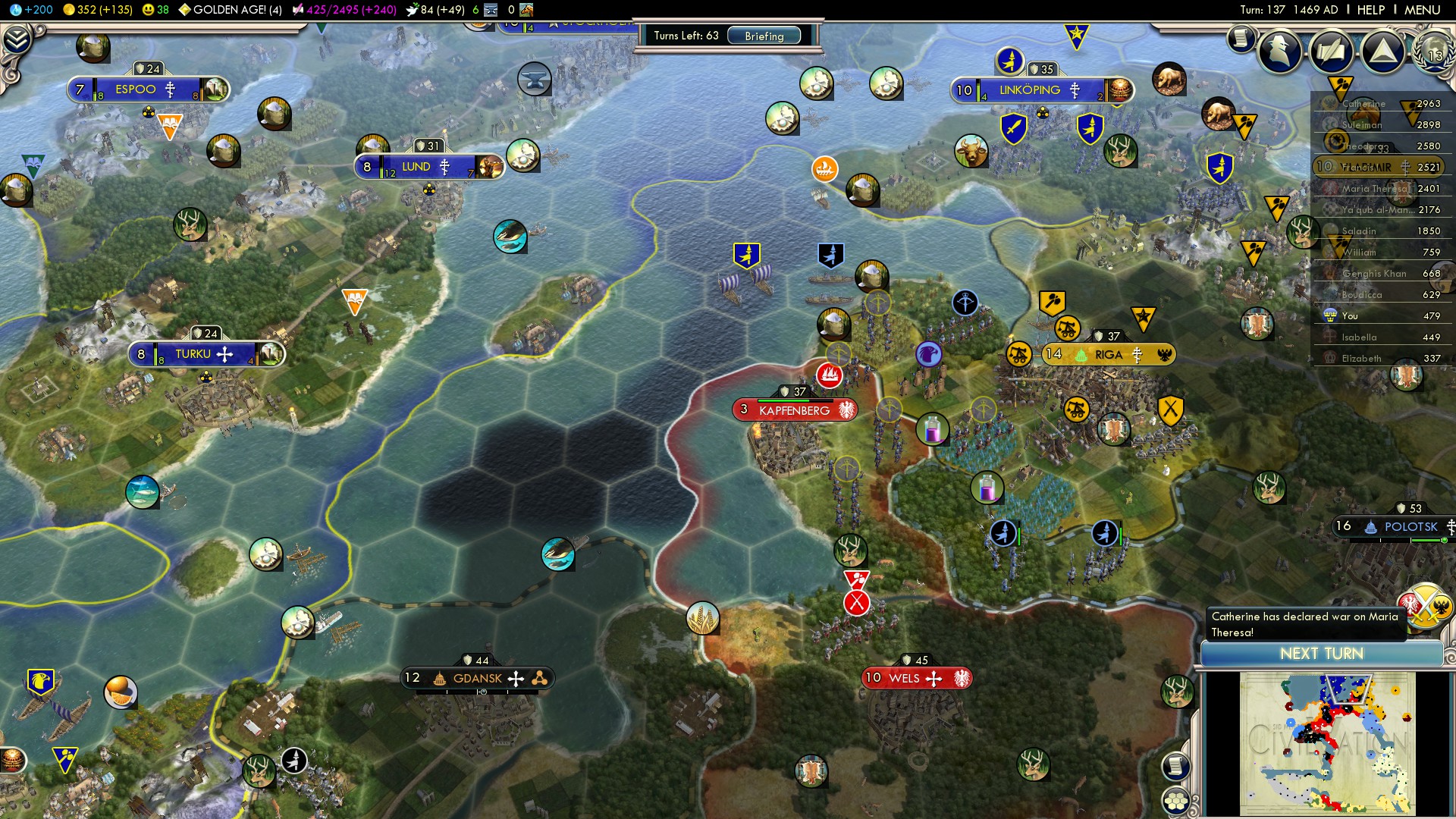
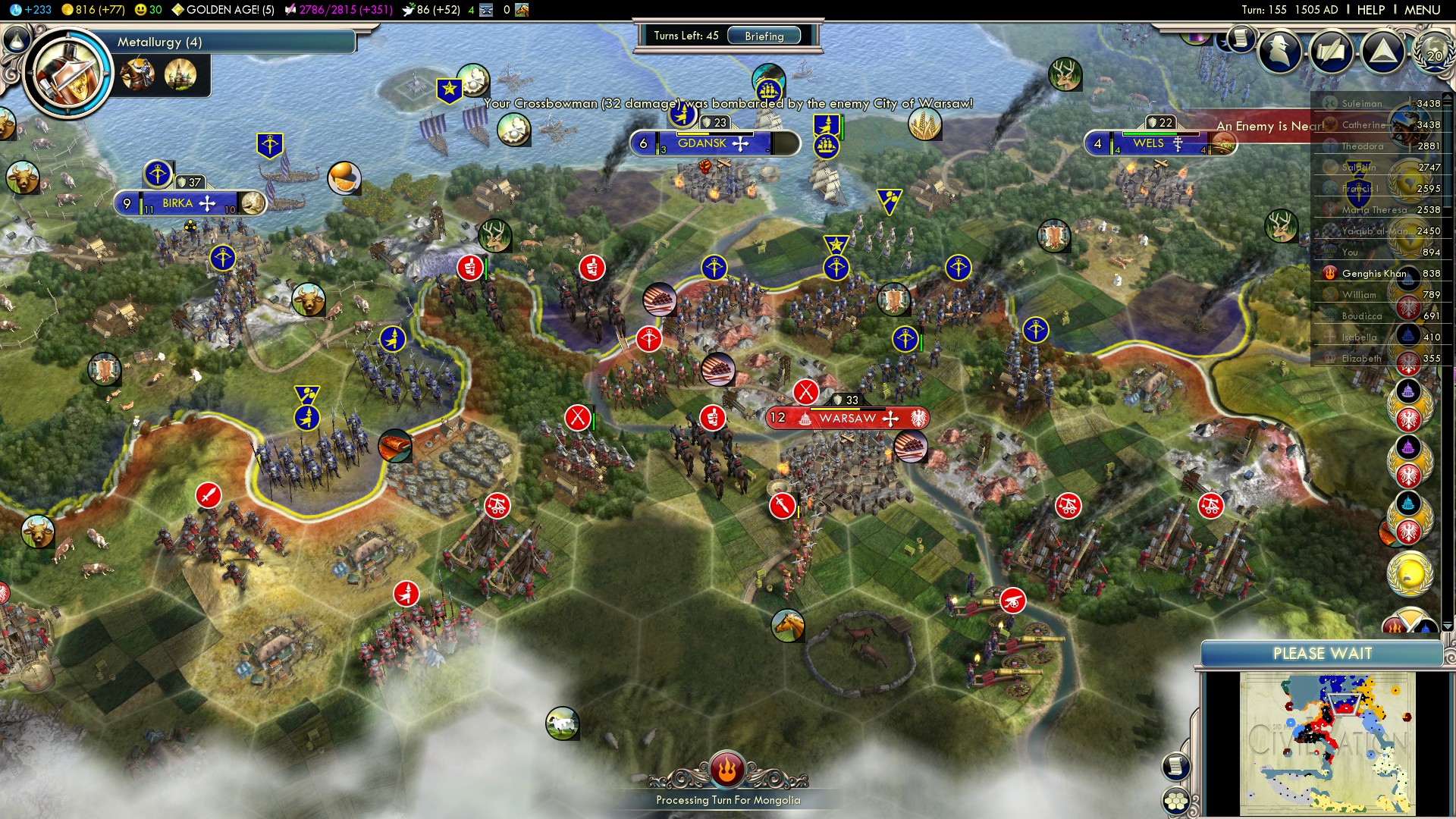
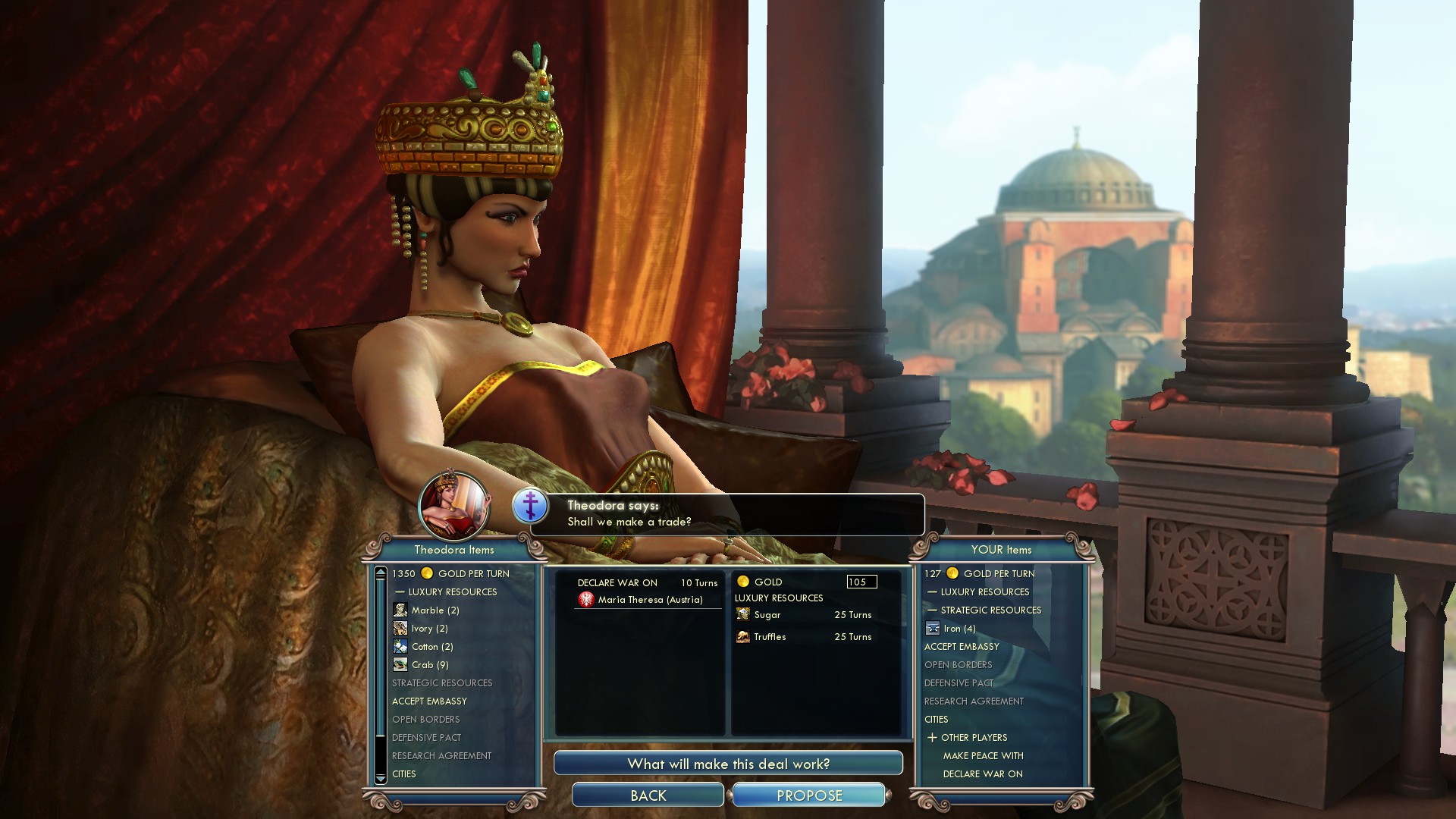
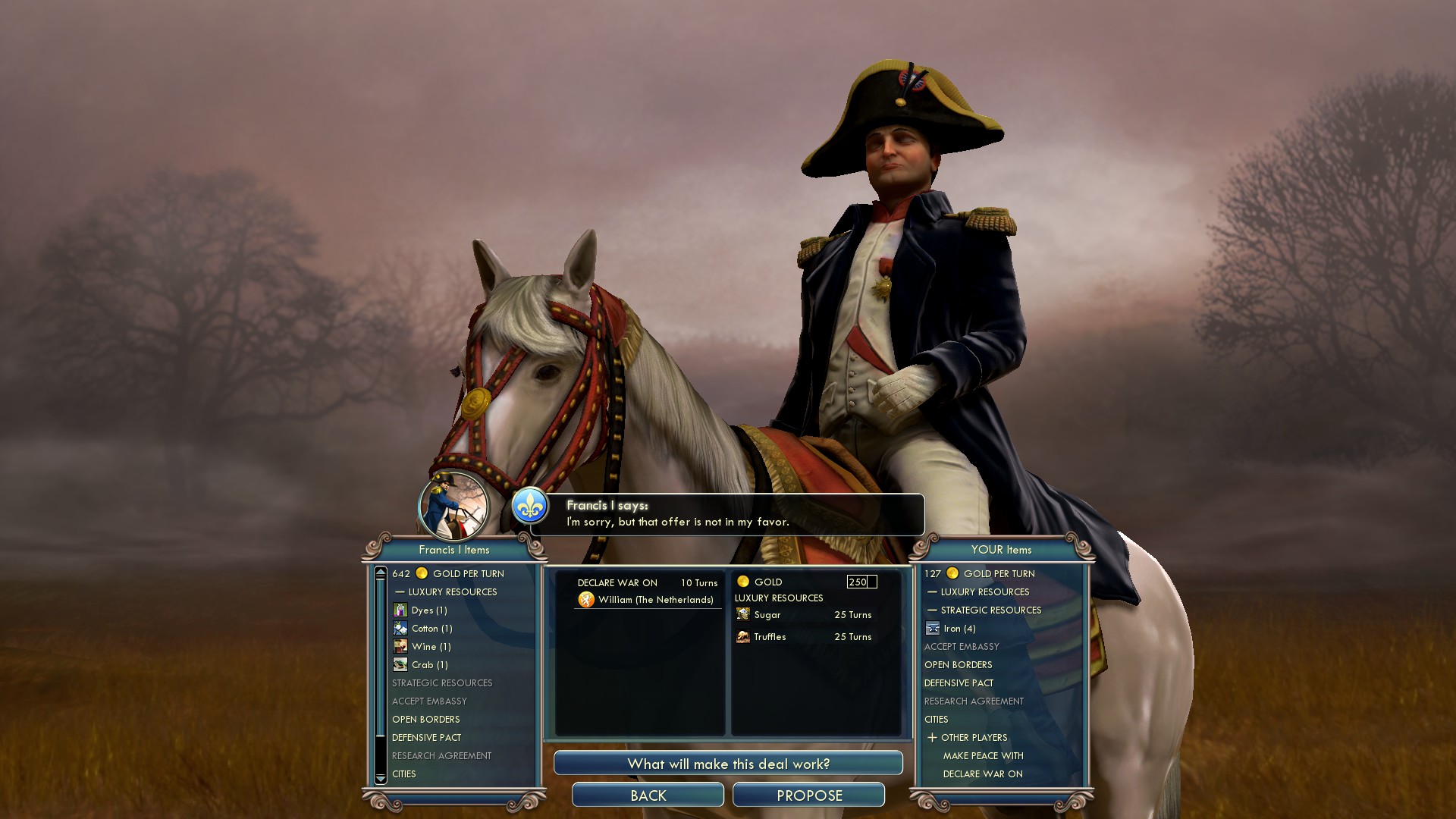
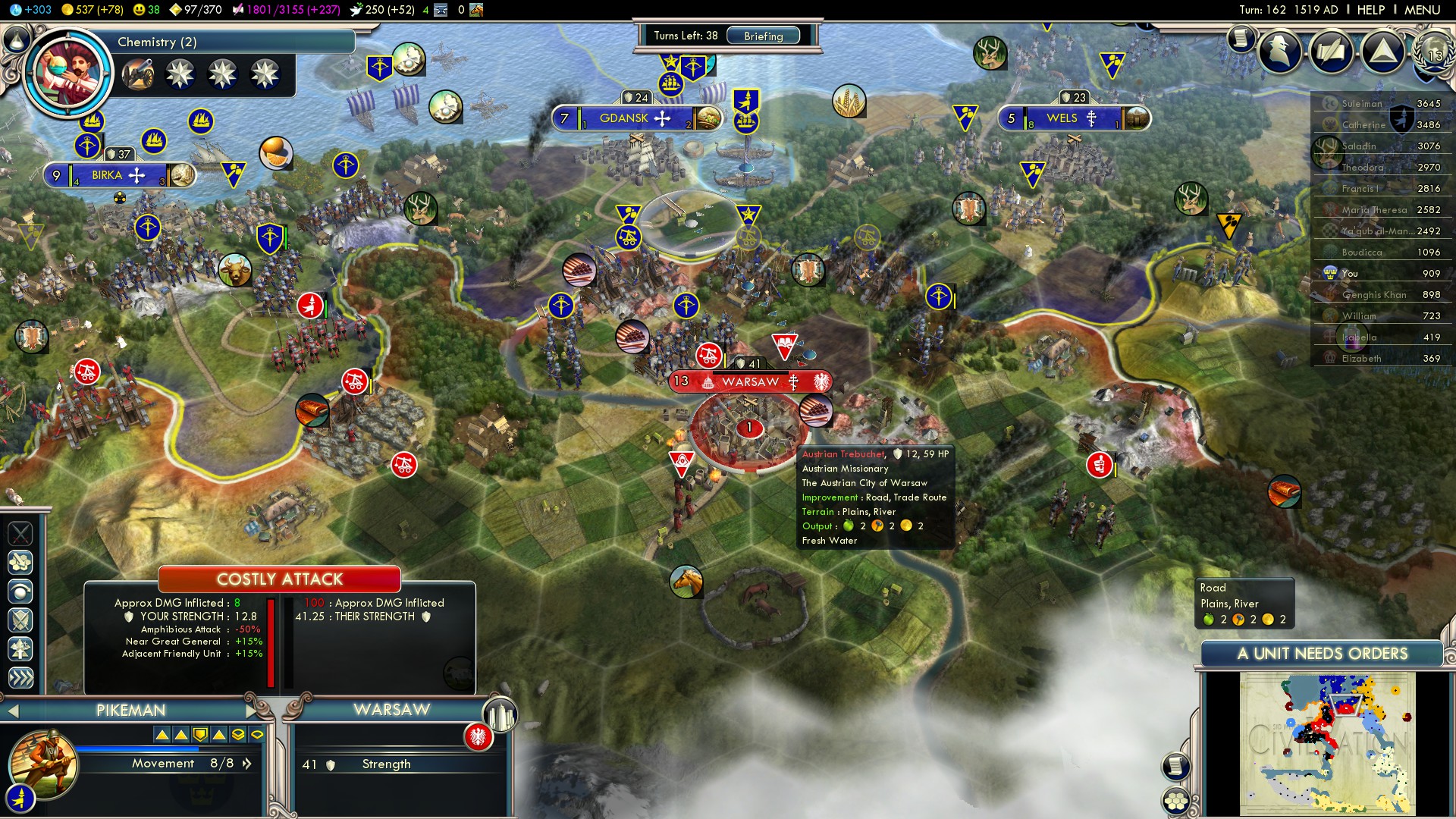
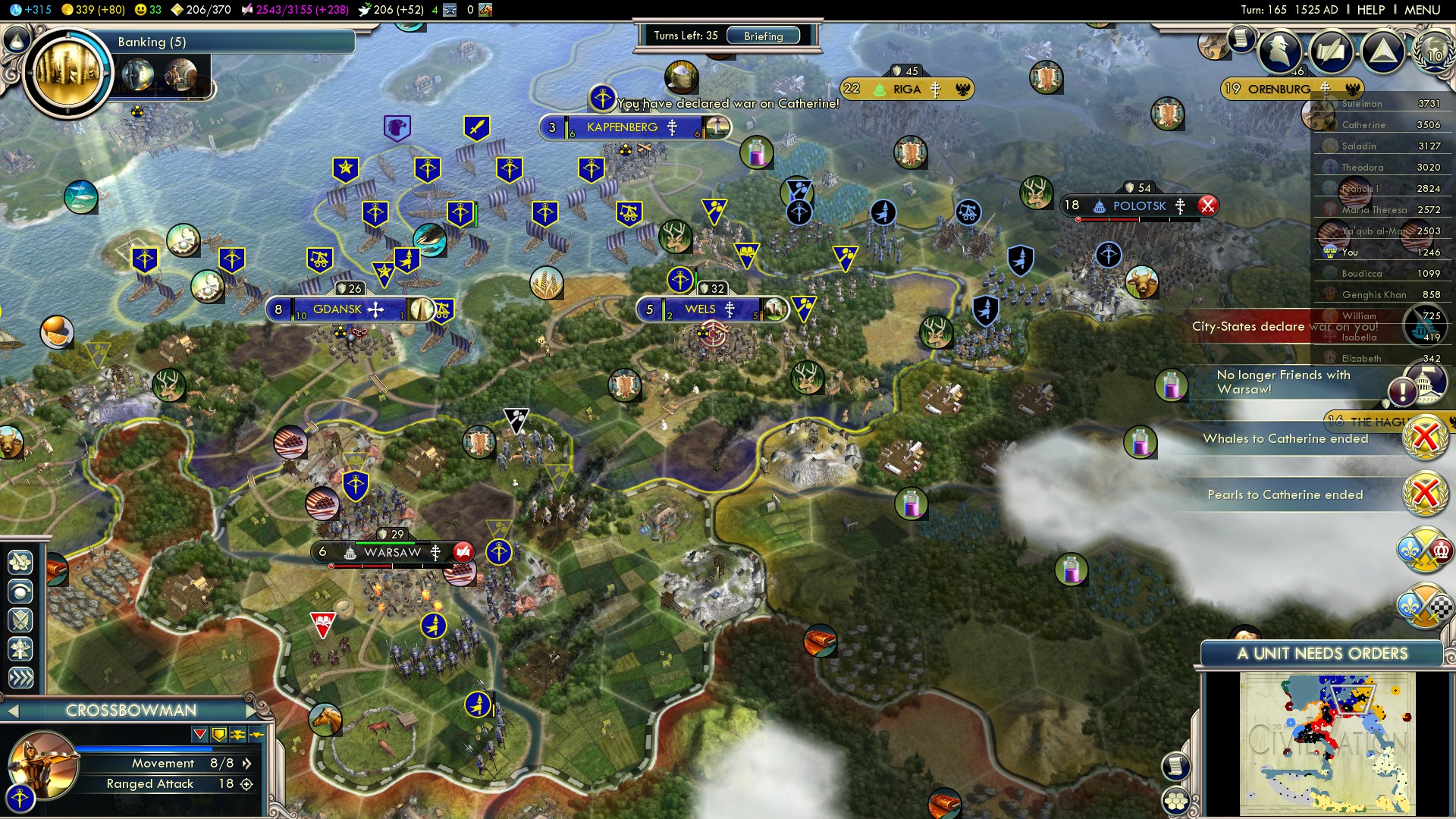
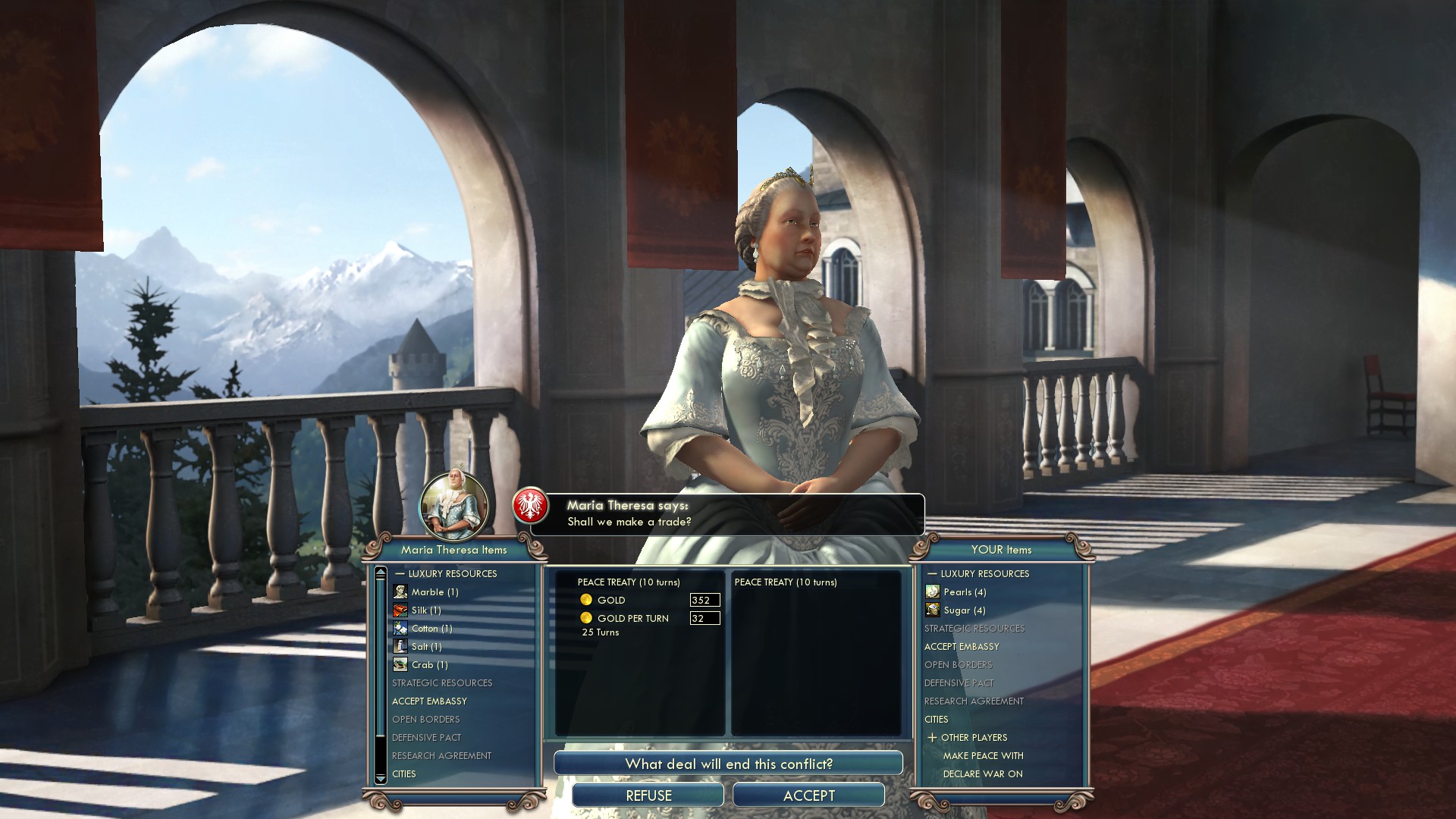
Of course you can only make peace after your AI friends made peace as well. Otherwise they will feel betrayed. Poor little fellas. (Because they will all be betrayed eventually…)
Main course: Swedish-Russian War
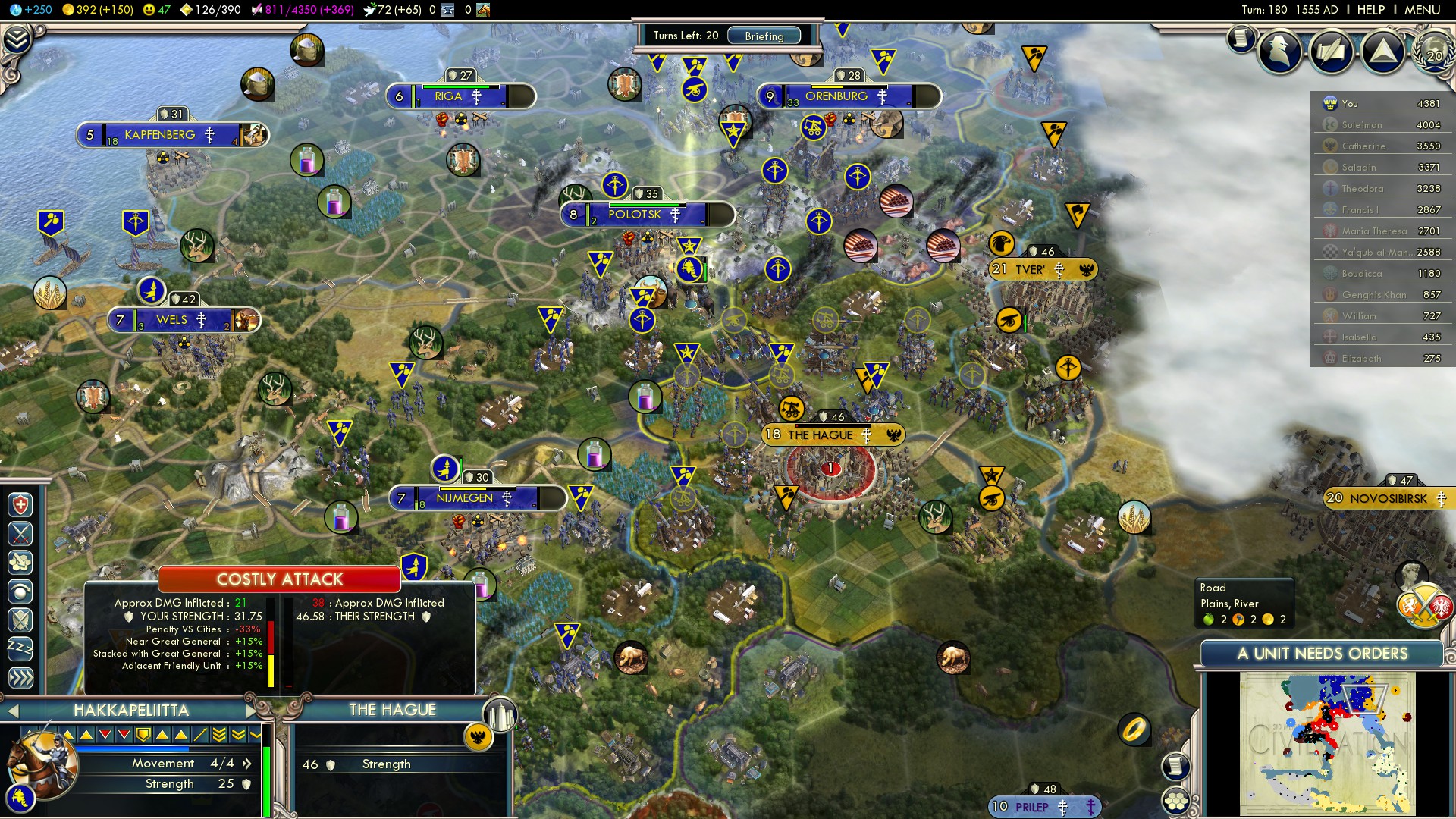
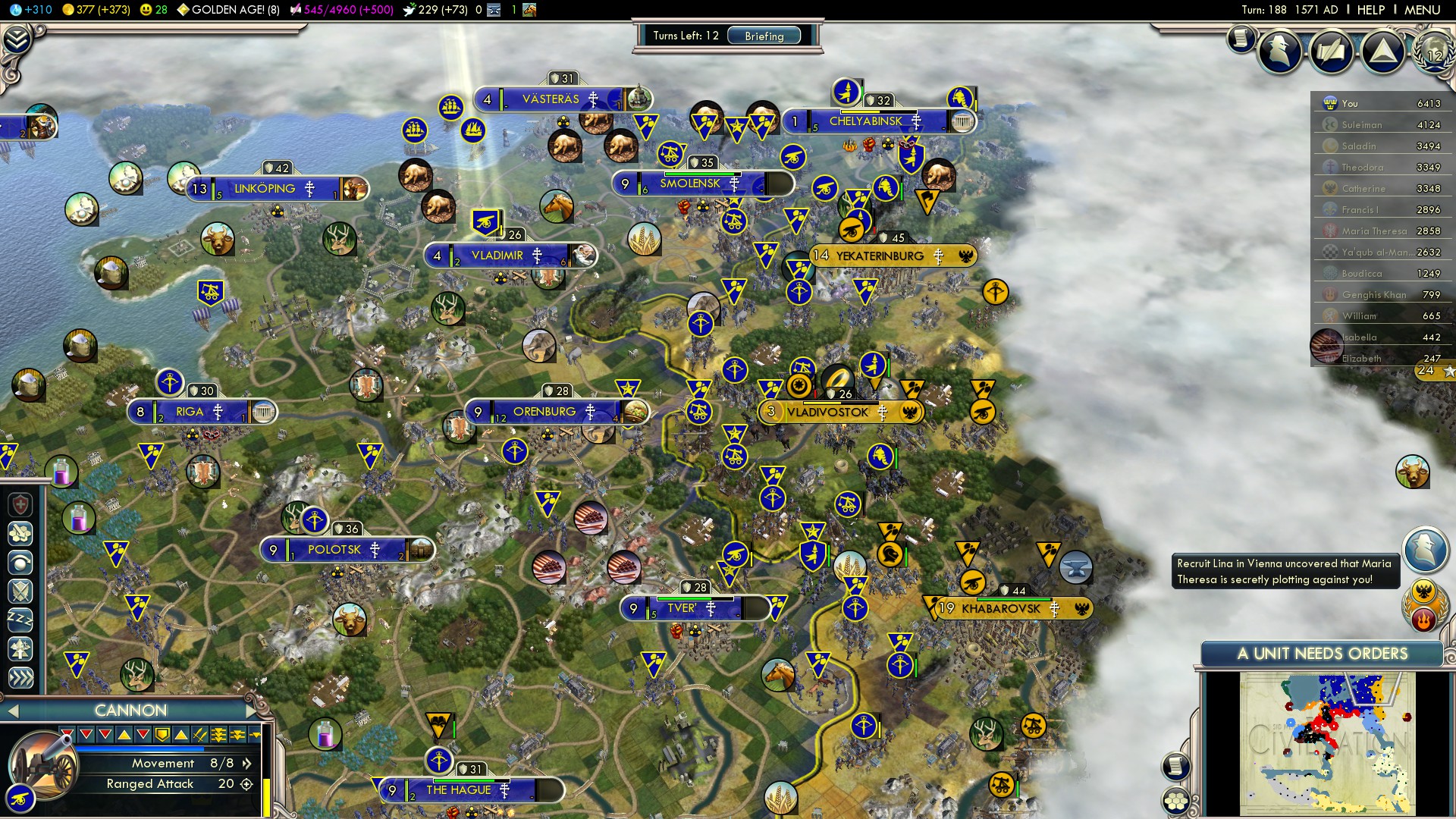
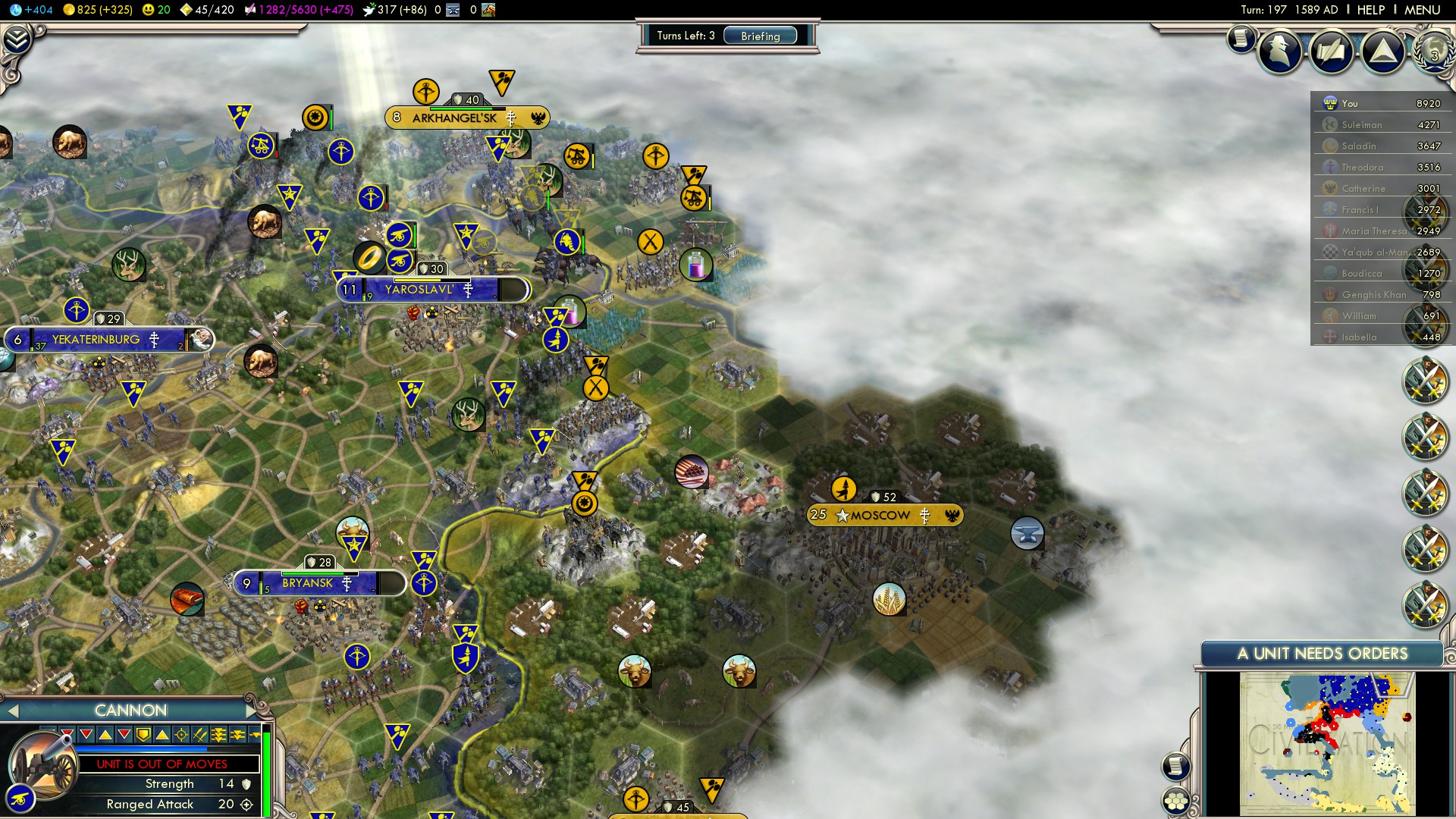
With the timer already showing turn 170, it’s only another 30 turns to defeat Russia and win the game. After the slow start of 3 cities in 30 turns, things sped up quite a bit: Another 30 turns yielded 16 captured cities (19 captured turn 140-200). All that while obviously also defeating the mighty Austrian and Russian armies.
| Turn | City (Population) | Yield | VP | Total VP |
|---|---|---|---|---|
| 168 | Riga (22) | — | 550 | 1,325 |
| 170 | Vladimir (13) | — | 325 | 1,650 |
| 174 | Polotsk (17) | — | 425 | 2,075 |
| 174 | Västerås (8) | — | 200 | 2,275 |
| 175 | Riga (12) | — | 300 | 2,575 |
| 177 | Nijmegen (15)* | — | 375 | 2,950 |
| 179 | Orenburg (19) | 215 G, 220 Culture | 475 | 3,425 |
| 180 | The Hague (18)* | — | 450 | 3,875 |
| 182 | Smolensk (18) | — | 450 | 4,325 |
| 184 | Tver’ (19) | — | 475 | 4,800 |
| 186 | Chelyabinsk (7) | — | 175 | 4,975 |
| 187 | Vladivostok (13) | 180 G, 160 Culture | 325 | 5,300 |
| 189 | Yekaterinburg (13) | 168 G, 220 Culture | 325 | 5,625 |
| 191 | Khabarovsk (16) | — | 400 | 6,025 |
| 192 | Bryansk (19) | — | 475 | 6,500 |
| 194 | Yaroslavl’ (22) | 261 G, 230 Culture | 550 | 7,050 |
| 196 | Novosibirsk (19) | 229 G, 220 Culture | 475 | 7,525 |
| 199 | Arkhangel’sk (8) | 119 G, 160 Culture | 200 | 7,725 |
*Dutch cities that just happened to be in the way of the Swedish war machine.
Conclusion, Lessons Learned & Key Differences to other guides
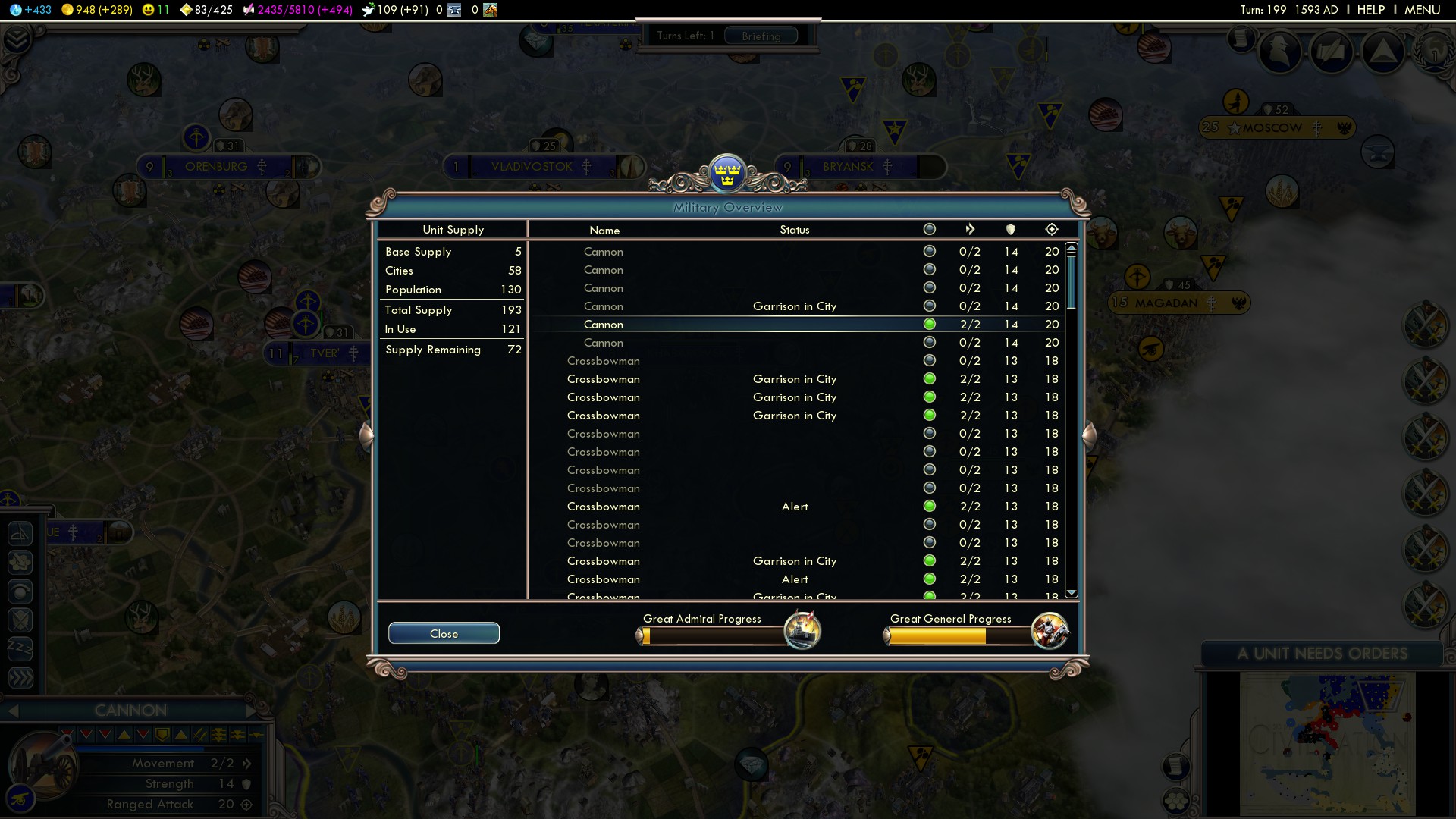
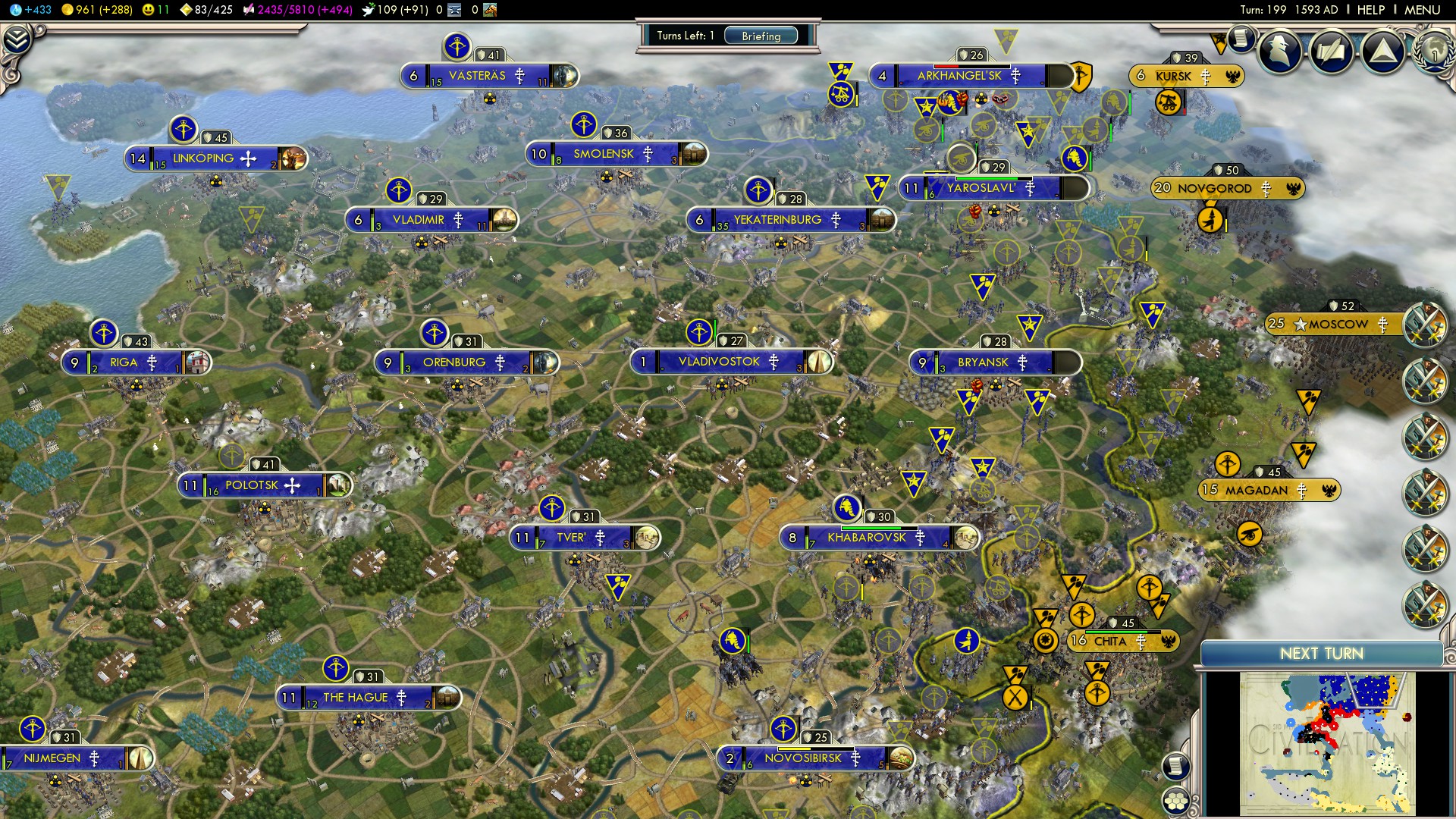
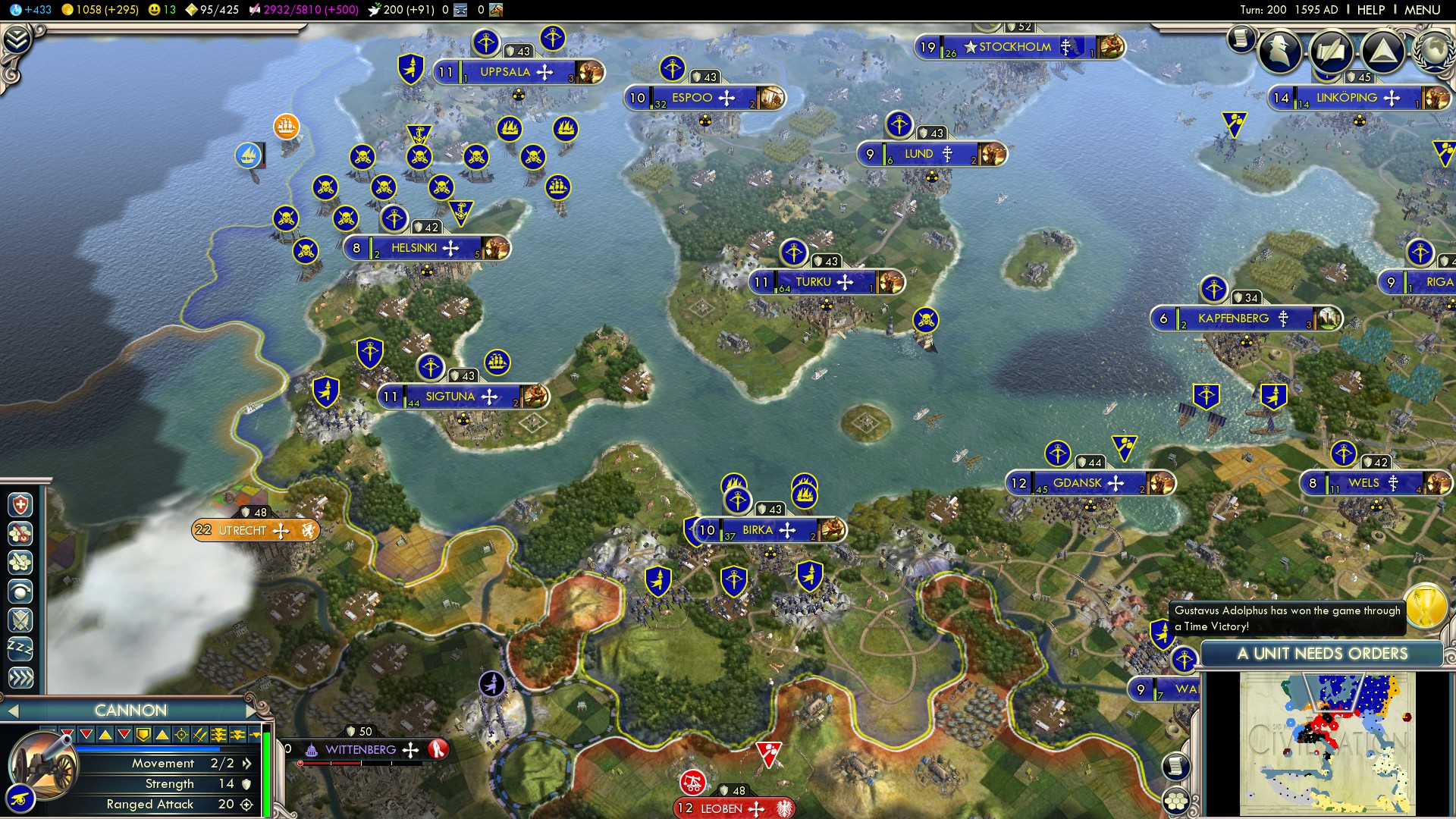
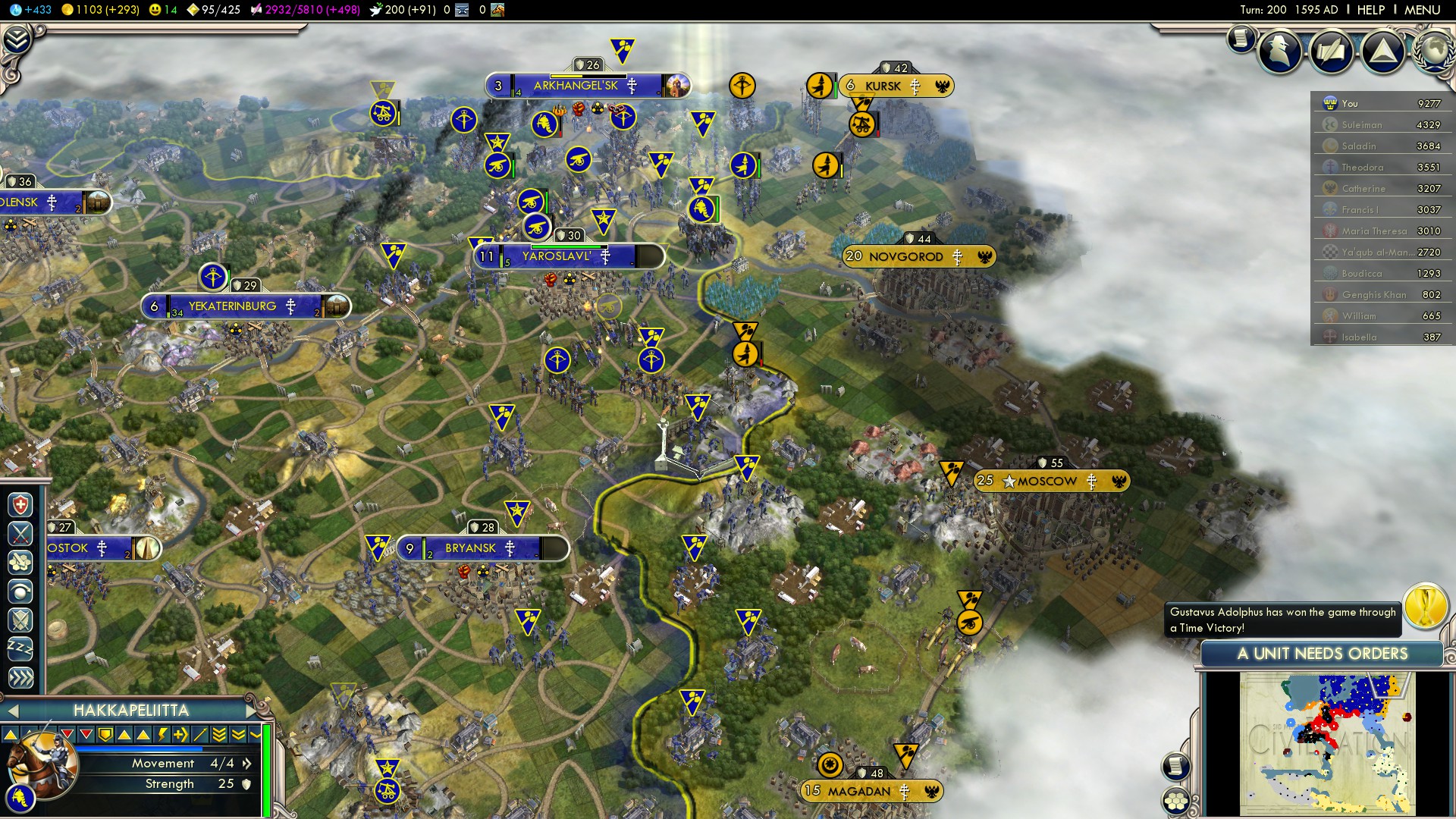
Playing Into the Renaissance Sweden on Deity difficulty requires a bold and aggressive approach centered on rapid territorial expansion. Rather than adopting a cautious strategy, we’re establishing an extensive 11-city network across Scandinavia and the Baltic region by turn 80. This early expansion is also powered by Sweden’s unique ability, Viking Fury, which grants embarked units extra movement and even Settlers can disembark without penalty.
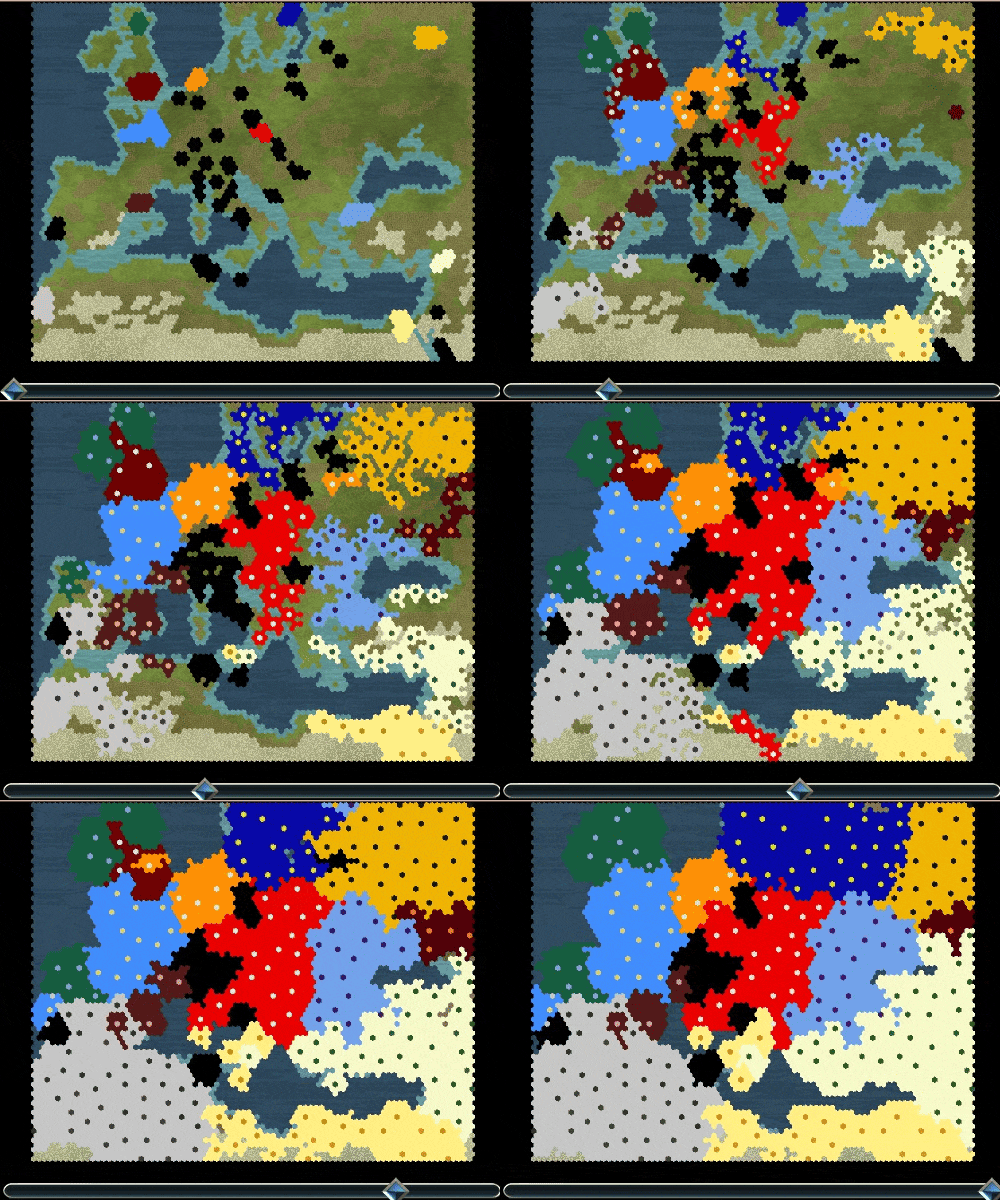
Economics
Economically, the empire sustains itself through early markets, maintenance-free Stave Churches and (different from continental Europeans) a technology path prioritizing Compass for early Harbors over early Xbows. Social policies heavily lean into Liberty for faster settlers, later pivoting through Commerce for Happiness and Honor for warfare, and finally adopting Autocracy to secure massive culture plunder from captured cities, transforming Sweden from a regional realm into an unstoppable military powerhouse.
Expansion
This aggressive, wide-empire strategy starkly contrasts with standard Civilization V Deity guides and general scenario walkthroughs, which typically feature a peaceful, tall game focused on three to four cities. Traditional guides strongly warn against wide play due to the punishing happiness penalties and intense AI aggression characteristic of Deity difficulty, often advising players to raze conquered cities to manage unhappiness. However, this Sweden-specific guide demonstrates that a passive or tall approach leads to being cornered and overwhelmed by expansionist rivals like the Netherlands and Russia. By defying conventional wisdom, we prove that proactive containment and aggressive empire-building are mandatory to survive the (soon) crowded map and secure dominance over Northern Europe.
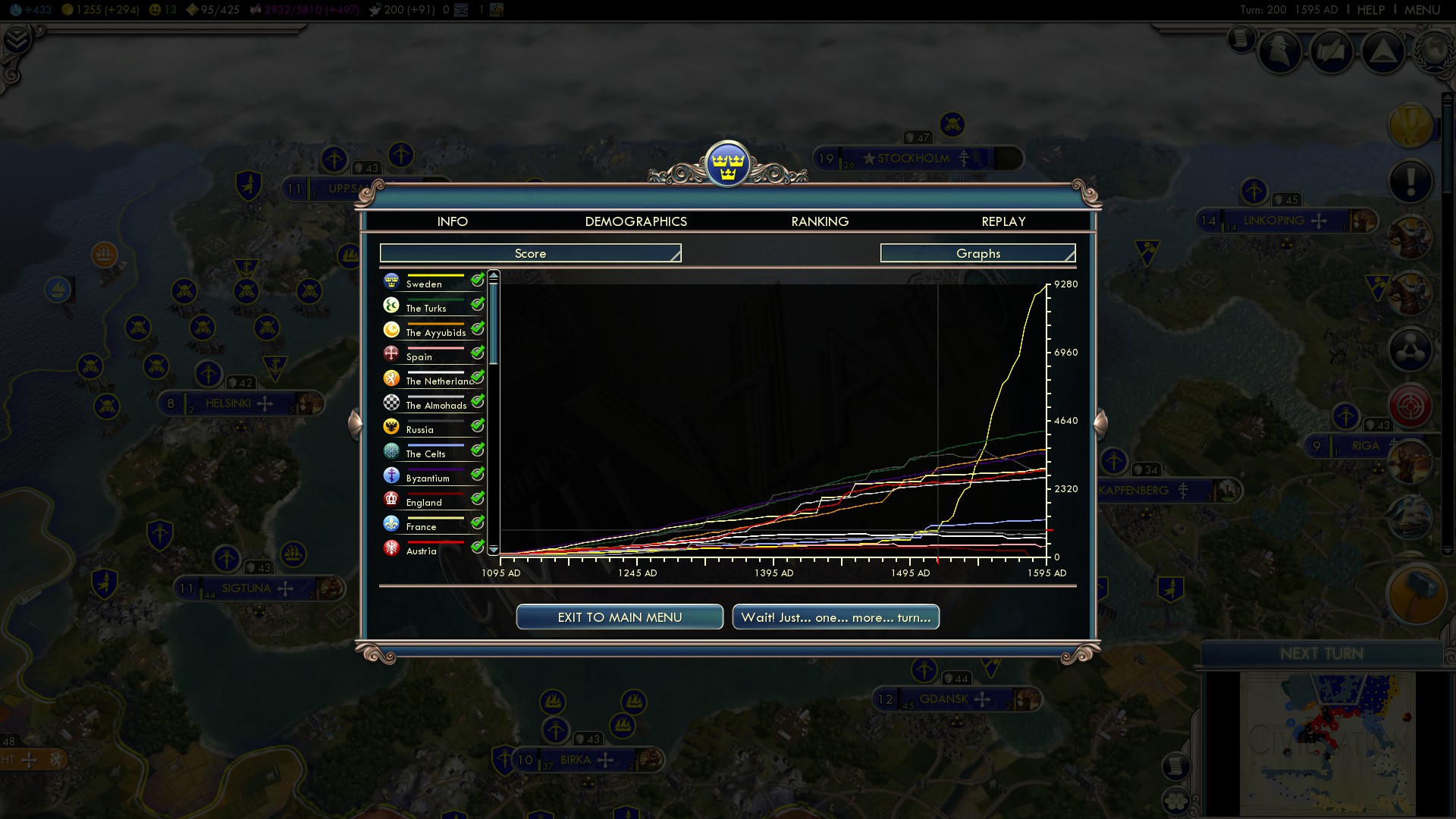
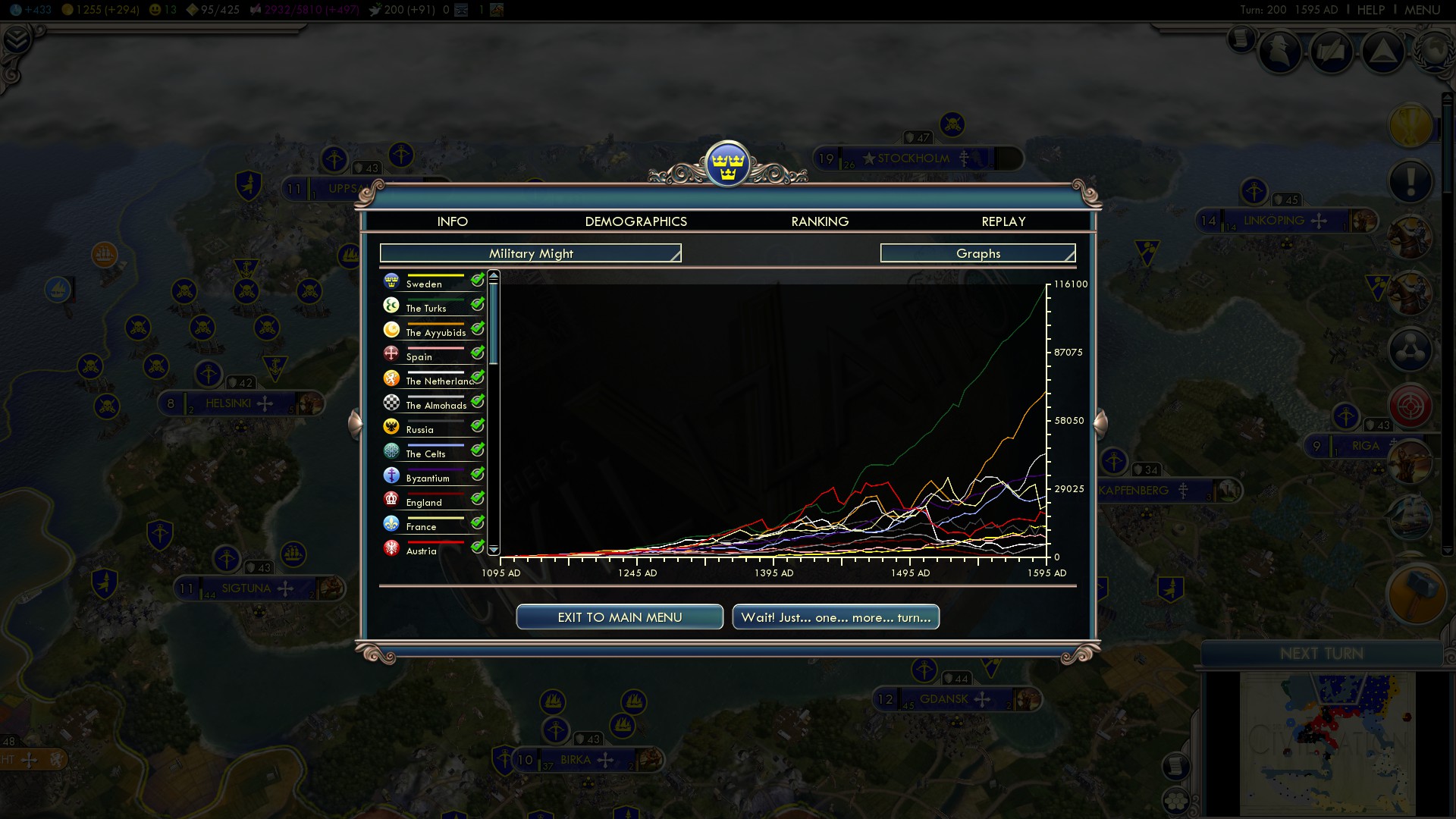
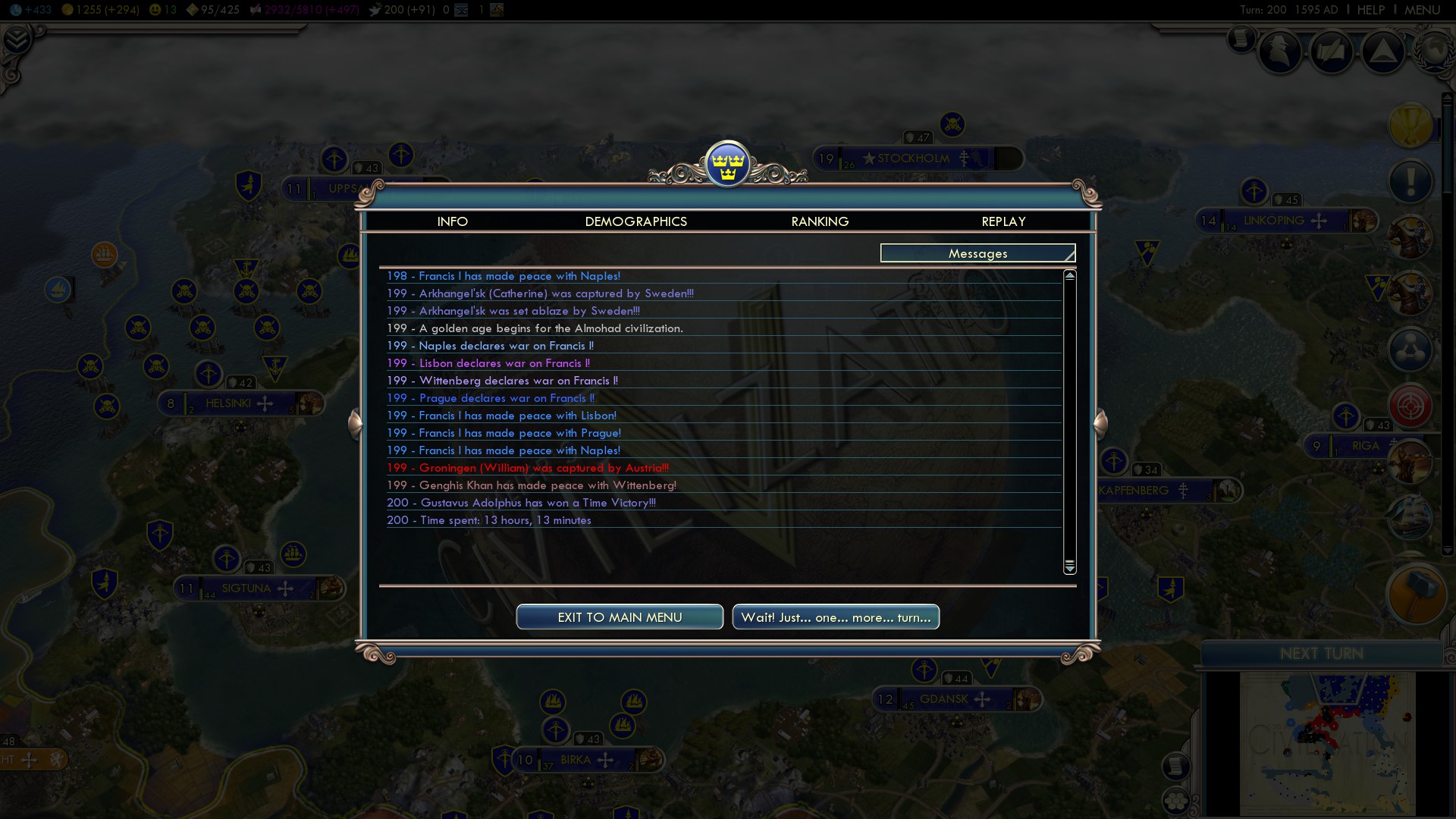
Ultimately, this unique wide strategy was essential for securing victory because the Into the Renaissance scenario is fundamentally a race for Victory Points awarded through conquest of foreign religion cities. Only aggressively blocking European powers early on, Sweden can deny them vital coastal access and naval supremacy. The combination of early choke-point settlements and the unmatched tactical mobility of Viking Fury enabled the Swedish army to sweep through enemy territory, capturing nearly twenty high-value cities from Austria and Russia in the late game.
Strict micro-management of local city happiness prevents crippling combat penalties while retaining conquered populations. By rejecting standard passive play in favor of a relentless, expansionist military campaign, we unlock the true potential of Sweden’s unique traits, turning an exceptionally punishing scenario into a decisive Deity victory.
Disclaimer & Outlook
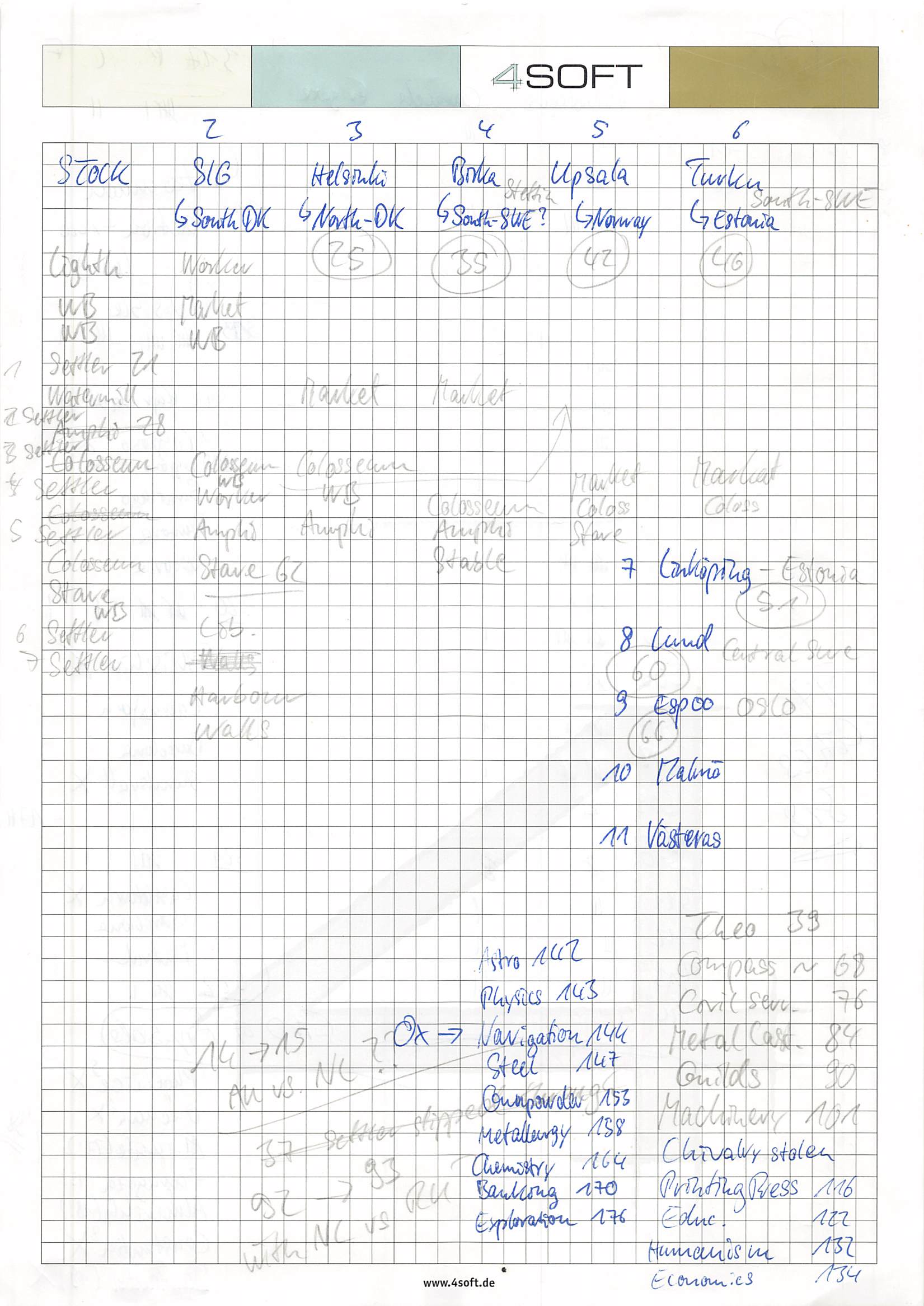
Of the dozens of Strategy and Achievement guides on this page, this is the first and so far only one that has been co-created by Gemini. It was the only way to make sense of a game played in 2018 based on ~170 screenshots in a folder of 700 Sweden screenshots and several pages of handwritten notes. Content still underwent careful editing by the Supreme Leader of Civ 5 scenario guides: Me.
Hope you enjoyed it and/or found it helpful! 🙂